




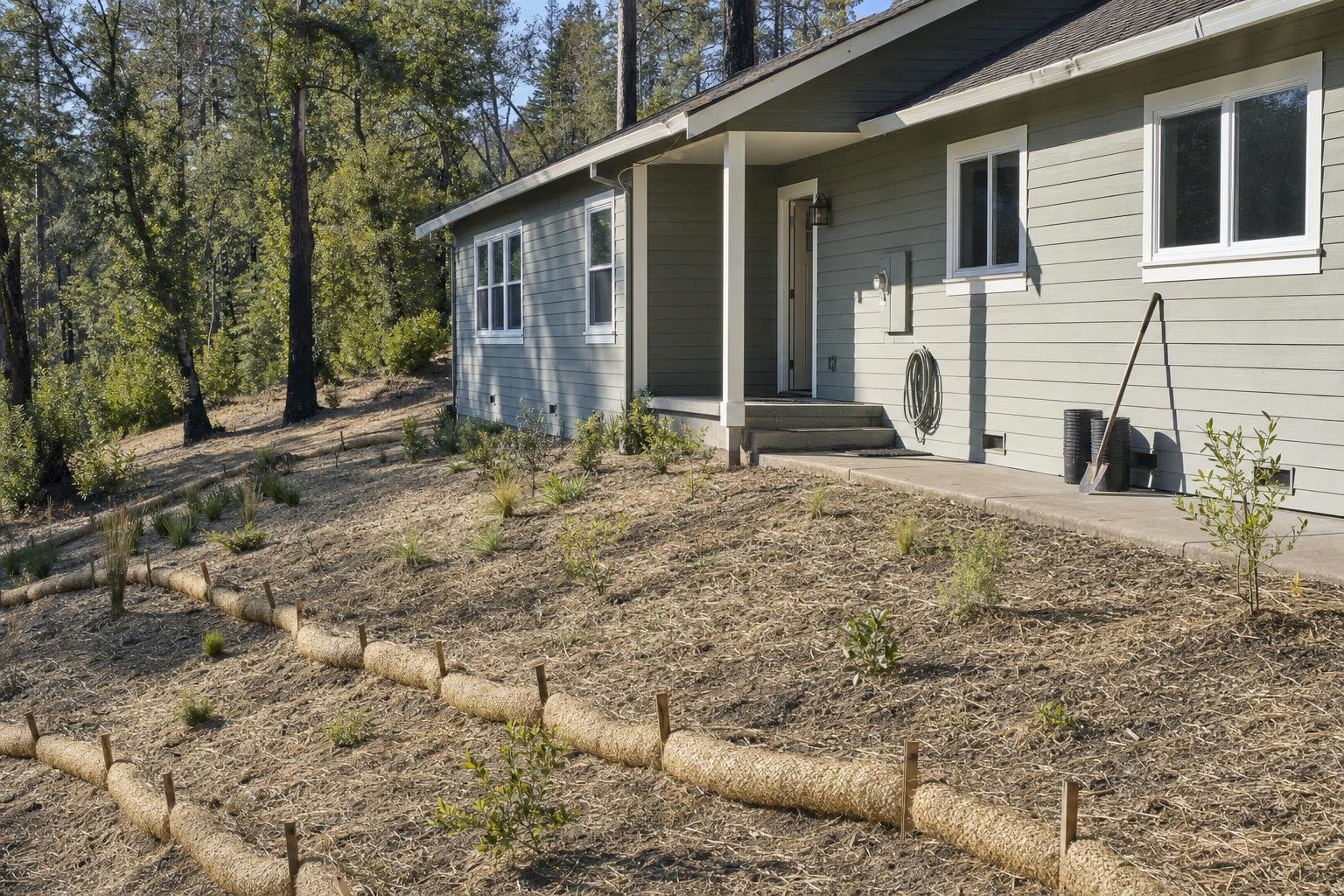
A burned yard looks like the emergency. On a Santa Cruz Mountains property the bigger threat is the rain that comes after it. The weeks between a late summer burn and the first real storm decide whether you spend next year replanting or hauling your hillside back out of the road.
The deadline is the first storm
Santa Cruz County treats October 15 as the line. The county's own erosion control plan requirements say erosion control measures have to be in place between October 15 and April 15, or any time rain is forecast, and that grading in that window needs a winter grading permit.
Those rules are written for graded construction sites, not your back slope. It is still the right calendar, because it is built around when this county actually gets wet. If your property burned in August or September, you have weeks, not months.
Order of work matters. Ground cover first, planting second, design last.
Your soil probably repels water now
When vegetation burns hot it releases a waxy substance that soaks into the soil as a gas and then sets. UC Master Gardeners describe the result in their piece on mitigating the effects of fire on your soil: the ground turns about as water repellent as pavement, and it looks completely normal while it does.
A slope that drained fine for twenty years now sheds water instead of absorbing it. Rain that used to soak in runs off the surface, picks up ash and loose soil, and arrives somewhere downhill all at once.
When we walk a burned property we pour a little water on the bare ground and watch. If it beads up instead of sinking in, we plan for runoff. There is no product that fixes this on a Tuesday. It breaks down over a season or two. Until it does, your job is to keep rain off bare dirt and slow down whatever runs.
Cover the bare ground before you plant anything
Covering bare soil is cheap and fast, and in the first winter it does more than any planting will.
- Weed free straw, spread thick enough that you cannot see much soil through it. Certified weed free matters. Ordinary bales bring their own seed bank with them.
- Straw wattles staked across the slope on contour, not up and down it. They slow runoff and spread it out instead of letting it cut a channel.
- Keep culverts, swales, and the bottom of every drainage path clear. Ash plugs them fast, and a plugged outlet turns a manageable winter into a washout.
If the slope is steep or has moved before, that is a bigger job than mulch and straw. More on that in our post on hillside erosion control in Santa Cruz.
The seed mix with our county's name on it is the one to skip
There is a product sold around here called the Santa Cruz Erosion Control Mix. After a fire it sounds like exactly what you want. It is the one thing to avoid.
The Resource Conservation District of Santa Cruz County publishes a flat out warning: do not use the Santa Cruz Erosion Control Mix. It contains non native plants with weedy attributes, specifically Blando brome, Hykon rose clover, and Zorro fescue. They spread on wind, water, animals, equipment, and people. Once they are established the RCD says they are almost impossible to remove, and they crowd out the native bunch grasses you want holding that hillside in ten years.
It used to be widely recommended. That is why it is still on shelves and still in old specs.
For that first winter the RCD suggests a sterile grass that germinates fast and will never become a problem: common barley or sterile wheat. The county's example erosion control plan calls for annual winter barley too, so the local agency and the local rulebook land in the same place.
While you are at it, skip the old standby cover plants. The same RCD sheet lists ivy, iceplant, periwinkle, jubata grass, and broom as plants that should not be used for erosion control here.
What to replant, and when
Give it a beat. Severely burned soil is a poor place to spend money on plants, and rushing usually buys you a second round of the same work.
Oak and madrone commonly resprout from the base after a fire, so a tree that looks finished in October can be pushing new growth by spring. Cutting it down in month one removes a root system that is already holding your slope together. Unless a burned tree is a hazard to the house, the driveway, or a neighbor, wait a season and see what it does.
For what you do put in, fall is the window here. Natives planted from late September into November get the whole wet season to root before they face a dry summer. We wrote up the timing in our post on fall planting in Santa Cruz.
For long term hold on a slope, native grasses and shrubs beat anything annual, because the roots go deep and stay. The RCD's own short list is a good starting point: meadow barley, blue wild rye, creeping wild rye, purple needle grass, and California brome. The tradeoff is that natives take a few seasons to establish, which is why the barley goes in first and the natives go in behind it.
Replant with the next fire in mind
With the ground open, this is the easiest time you will get to fix the fuel layout around the house. Plant in islands with real space between them instead of a continuous band of shrubs against the siding, and keep the first five feet off the wall lean.
We cover the zones and spacing in our post on defensible space landscaping in the Santa Cruz Mountains, and we work all through the mountain communities, including Boulder Creek.
The Resource Conservation District also keeps a post fire resource page for county landowners, worth reading before you buy anything.
Frequently Asked Questions
How soon after a fire should I start work on the landscape?
Start the ground cover work immediately and finish it before the first real storm. Replanting can wait until the fall planting window or even the following year, but bare soil on a slope cannot wait at all.
Is my soil ruined after a fire?
Usually not. The water repellent layer breaks down on its own over a season or two, and ash is not the problem people assume it is. The real damage is what happens to unprotected soil in the first winter.
Should I remove burned trees right away?
Only the ones that are a hazard to people, structures, or access. Oak and madrone often resprout from the base, so give the questionable ones a growing season before you decide.
Get a Free Estimate
PGS has been working Santa Cruz and Monterey County yards for over 40 years, plenty of them slopes that have been through a fire. If your property burned and you are trying to get ahead of the rain, give us a call at 831.254.3447 or reach us through our contact page and we will come look at it with you.