




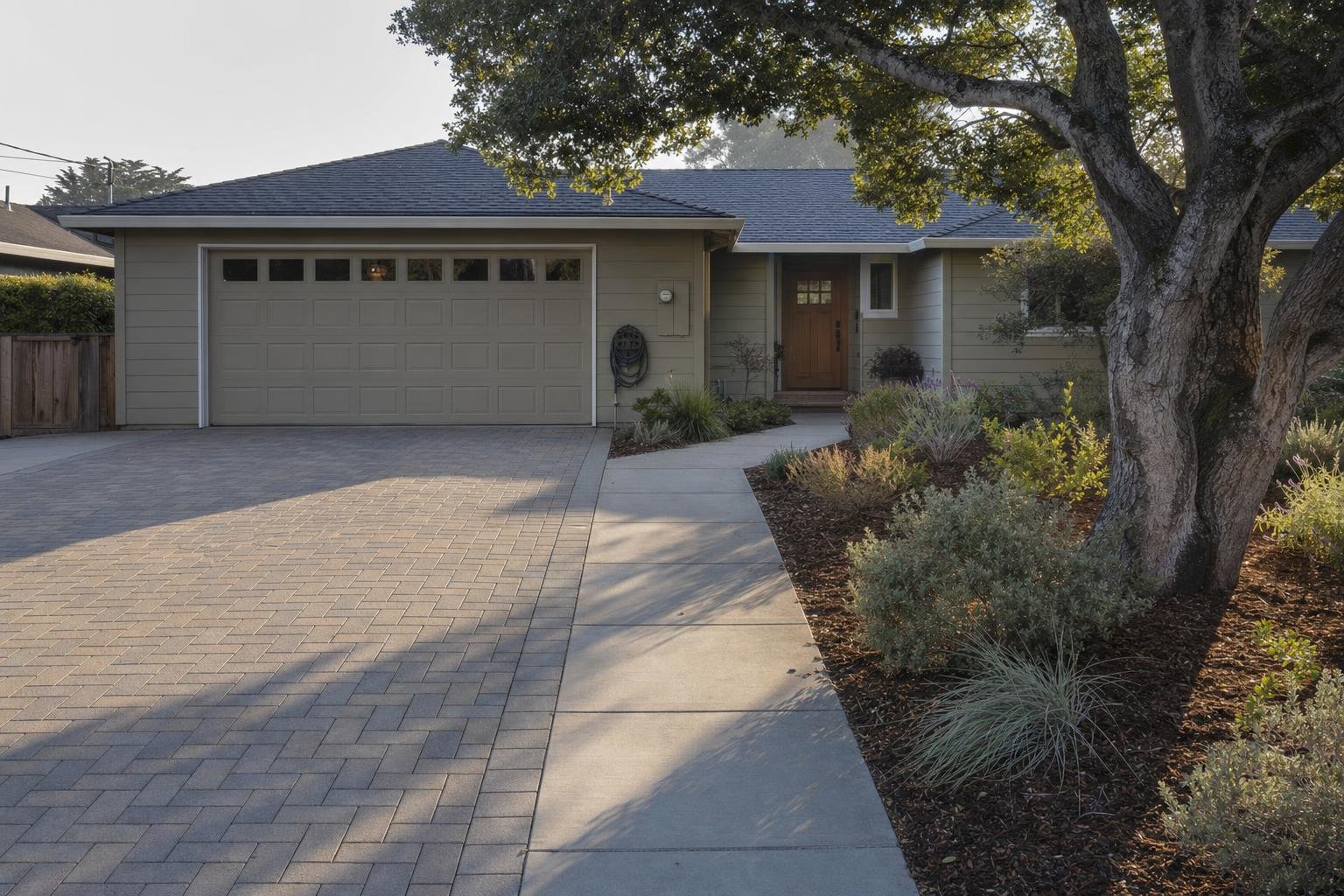
We get asked this one on almost every driveway and patio estimate. Pavers or concrete? We install both, and neither one is the right answer everywhere. What decides it here is mostly the ground under the slab, the trees next to it, and how much shade and fog it sees. Here's how we walk people through it in Santa Cruz County.
How each one is built
A poured slab is one solid piece. We grade the ground, put down compacted base rock, set forms and rebar, pour, and cut control joints so the cracks that come later (and they do come) land in straight lines instead of wandering across the middle.
Pavers are a lot of small units sitting on compacted base and a thin layer of bedding sand, with sand in the joints and a solid edge holding everything in. Nothing is glued together. The pieces lock against each other, and that lets the surface flex a little when the ground moves. For anyone who wants the technical version, the Concrete Masonry and Hardscapes Association's application guide covers base depths and edge restraints for patios and driveways.
Either one is only as good as what's underneath it. Most of the failures we tear out had a thin base or no drainage.
What our ground does to a slab
Much of the county sits on clay. Scotts Valley, a lot of Watsonville and Corralitos, and plenty of the hills behind Aptos all have soil that swells when it's wet and shrinks when it dries out. Over enough winters, a slab on that ground cracks. A good base and proper joints slow it down, but they don't stop it.
Pavers ride that movement better. If a section settles or heaves, we lift the pavers, fix the base, and set the same pieces back. With concrete, a bad crack usually means cutting out a section, and the patch never quite matches the rest.
Down near the beach it's a different story. The sandy soil in Live Oak, Capitola, and La Selva Beach drains well and doesn't move much. Concrete holds up fine there, and the decision comes down to looks and budget more than the ground.
Roots, shade, and the fog
Redwoods, oaks, and old street trees are the other thing that breaks slabs here. Roots grow under the concrete, lift it, and crack it. The fix is often cutting and repouring a whole panel. Under pavers, we can pull up the area over the root, deal with it, and relay the same stones.
Shade and fog cause their own problems. On the north side of a house or under redwoods, pavers grow moss in the joints, and the moss holds water. Concrete in the same spot grows a slick green film that can get slippery in winter. Either way it means cleaning now and then. Polymeric joint sand cuts down on weeds and moss in the paver joints, and a broom finish on concrete gives your shoes something to grip.
Steep driveways in the mountains
For a steep driveway in Boulder Creek, Ben Lomond, or Bonny Doon, we usually lean toward concrete with a heavy broom finish or a grooved surface. A steep run of pavers can creep downhill over the years unless it's built with a concrete band or strong edges at the bottom and along the sides. Cars braking and turning on a grade push on it every day.
That doesn't rule out pavers on a slope. A paver apron at the top, or a paver walkway alongside, can look great with a plain concrete run doing the climbing. Our driveways page shows the materials we work with.
Patios are a different call
A patio doesn't carry cars, so the case for pavers is even stronger there. You get more patterns, colors, and edges, and you can tie the patio into walls, steps, and planting beds without a lot of forms. It's also easy to add on later. Pulling up an edge row and extending a paver patio is a much smaller job than matching new concrete to an old pour.
Concrete still makes sense for a simple, clean patio with a modern look, or when the budget is tight and the ground is stable. We go through more options on our patios page, and if you're also weighing what a paver patio involves, our post on paver patio planning in Santa Cruz covers it.
Upkeep
Concrete is mostly leave it alone. Sweep and rinse it now and then, and seal it if you want it to resist stains. You will get some cracks over time.
Pavers want a little more attention. Joint sand washes out in heavy rain and needs topping up, and ants like to dig in the joints. Sealing every few years keeps the color and holds the joint sand, though plenty of people skip it. In exchange, you can fix any part of it without a saw, and a stained or broken paver just gets swapped.
Check the drainage rules before you pave
Any new hard surface changes where the rain goes. If your driveway or patio is part of a permitted project in the unincorporated county, the county's Public Works building permit guidance says new or replaced paved areas get stormwater review, and the requirements step up once you pass 500 square feet. Inside city limits, the City of Santa Cruz stormwater requirements list driveway and patio expansions among the projects that may need to send runoff into planting areas or a rain garden.
Whatever material you pick, it should drain away from the house and into soil, not down the driveway into the street. Getting that right is part of any hardscape job we do.
Frequently Asked Questions
Are pavers better than concrete in Santa Cruz?
On clay soil, near big trees, or anywhere you might want to dig under it later, usually yes. On stable sandy ground near the beach, or on a steep driveway, concrete often makes more sense.
Do pavers last longer than concrete?
A well built paver surface can be repaired one section at a time, so it tends to stay in service longer. A slab can last a long time too, but once it cracks badly the fix is usually a cut and repour.
Can pavers go over an existing concrete patio?
Sometimes, if the old slab is solid and drains, and the extra height doesn't cause problems at doors or steps. A cracked or heaving slab should come out first.
Is stamped concrete a good middle ground?
It gives you a patterned look in one pour, but it still cracks like any slab, and patching it is hard to hide. If you like the look of pavers, we usually suggest the real thing.
Get a Free Estimate
We've been building driveways and patios in Santa Cruz County for over 40 years, in both pavers and concrete. If you want help figuring out which one fits your ground, call us at 831.254.3447 or reach out through our contact page for a free estimate.