




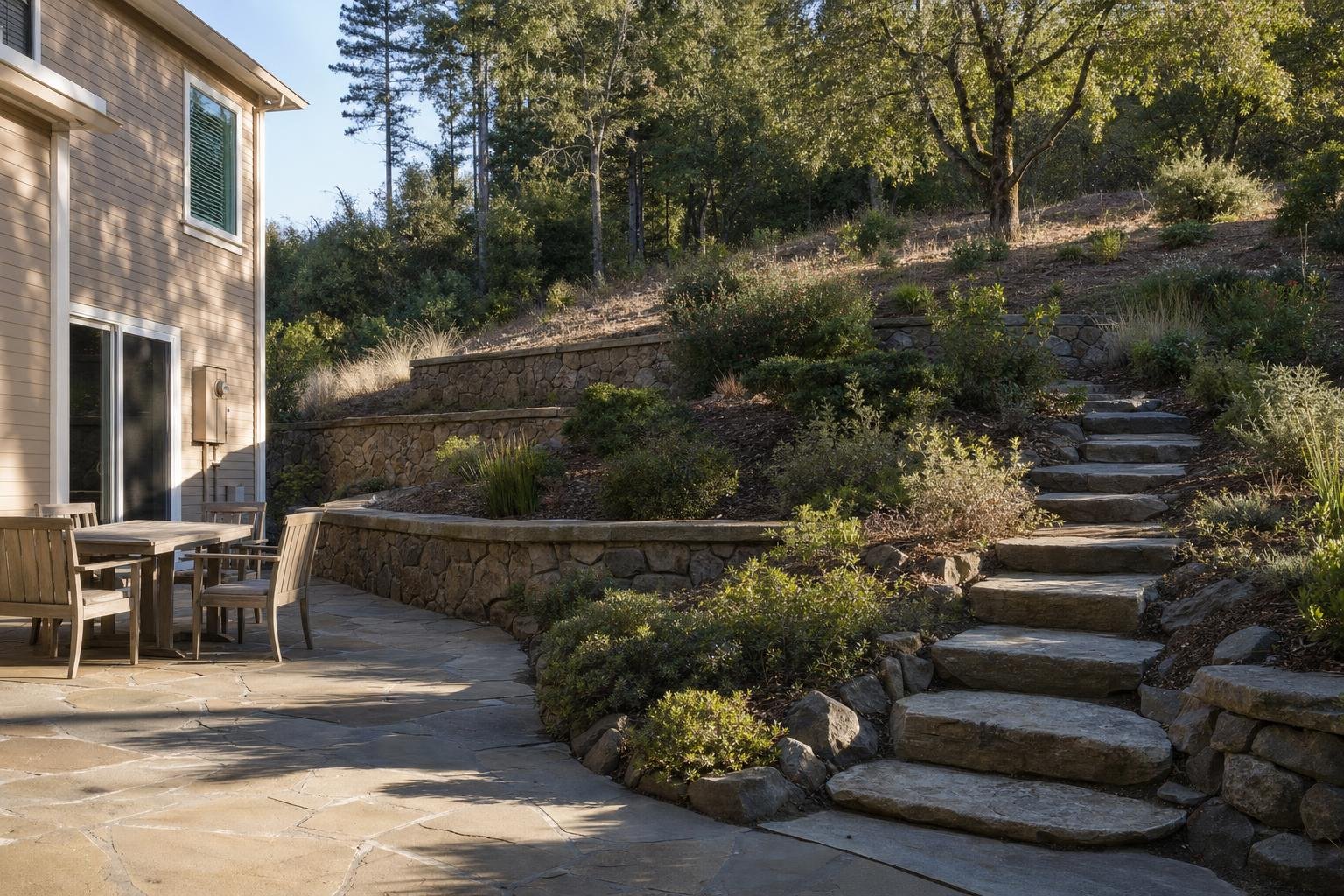
A lot of the yards we walk in Santa Cruz County aren't flat. Scotts Valley, the Aptos hills, Soquel, and pretty much everything up in the mountains are built on hillsides, and plenty of people end up with a backyard that's mostly bank. The idea pictures online tend to come from places with gentle grades and easy soil. This is how we think about a slope here, and the layouts we keep coming back to.
Start with what you want to do out there
Before anyone talks about walls, figure out what the yard is for. A spot for a table and chairs, a lawn for the kids, a vegetable bed, or just a hill that looks good from the kitchen window. Each one needs a different amount of flat ground, and on a slope the flat ground is where most of the work goes.
Most people want one good level area close to the house and are happy to leave the rest as planted bank. That's usually the right call. You get a place to actually sit, and you aren't building walls all the way up the hill.
It also matters which way the slope runs. A yard that climbs up from the back door feels closed in, and the water heads straight for the house. A yard that drops away from the house usually has a view and drains away on its own, but you need a safe edge and a way to get down to the bottom.
Terraces instead of one tall wall
Terracing is the layout we build most on hillside lots. You break the slope into two or three shorter steps, each with its own low wall and a flat bench behind it. One bench can be a patio, the next a planting bed, the top one a little sitting spot with a view.
Shorter walls are easier to build well and easier on the eye than one big wall at the bottom of the yard. They also matter for permits. Santa Cruz County's retaining wall permit rules say a wall under three feet that isn't holding up a surcharge, like a driveway or a structure, doesn't need a permit. Over three feet it does, and at four feet or taller the permit needs structural engineering. Retaining wall work often comes with grading too, and that can need its own approval. If you're inside a city limit, check with that city's building department, since the rules can differ.
Whatever the height, every wall needs drain rock, filter fabric, and a perforated pipe at the base behind it. A wall without drainage fills up with water every winter, and that's how walls start to lean. We go into wall materials on our retaining walls page.
A level patio on the uphill or downhill side
If you only want one flat area, the question is whether to cut into the hill or build out from it.
Cutting in puts the patio on solid ground, with a short wall on the uphill side that doubles as seating if you cap it at the right height. That's our favorite on smaller lots. Building out means filling behind a wall on the downhill side, which gets you more view, but the fill has to be compacted properly or the patio settles. Stone, pavers, and concrete all work either way, and our patios page goes through the options.
A deck is the other way to get flat space on a steep drop. It needs less earthwork and can reach farther out over the slope. We mostly build on the ground, but on a really steep grade it's worth looking at both.
Steps and paths that people actually use
On a sloped yard the path decides whether anyone goes past the patio. Steep, uneven steps get skipped, and then the upper half of the yard goes wild.
We like steps with a comfortable, even rise, and wide treads, so you can carry a tray or a bag of soil without watching your feet. On a long slope, a path that switches back across the hill is easier to walk than a straight run of stairs, and it slows the water down too. Flagstone, pavers, and decomposed granite with timber or stone risers all hold up here.
Planting the bank you don't build on
The parts you leave as slope still need to be covered. Bare ground on a hillside washes out in the first big storm, and once it starts to rill it keeps getting worse.
Deep rooted natives do most of the work here. Coffeeberry, ceanothus, manzanita, and sages hold the soil and get by on little water once they're in. Low spreading types fill the gaps between them. Plant in clumps with some open ground between them, mulch everything, and pin an erosion control blanket over the steeper parts until the roots take hold. Drip is the easiest way to water a slope, since sprinklers on a hill mostly run off before the water soaks in.
Fall is the best time to plant a bank here. The rain does a lot of the watering, and the roots have all winter to grab on before things dry out.
Don't forget where the water goes
Water from the roof, the neighbor's yard, and the hill above all crosses a sloped yard on its way down. The patio and walls have to send it somewhere safe instead of toward the house or over the edge of a wall.
The Resource Conservation District of Santa Cruz County offers free, confidential drainage and erosion consultations for county homeowners and has a good guide on slowing water down around a house. If your slope is already moving or washing out, start with our post on hillside erosion control before you think about patios.
Frequently Asked Questions
Do I need a permit for a retaining wall in Santa Cruz County?
In the unincorporated county, walls under three feet that don't hold up a surcharge don't need one. Over three feet they do, and walls four feet or taller need structural engineering too.
What's the simplest way to make a sloped yard usable?
Usually one level area near the house and planting on the rest. Every extra terrace adds wall, drainage, and fill, so keep the flat ground to what you'll actually use.
Can I put a lawn on a slope?
On a gentle slope, yes, but mowing and watering a hill is a pain and the water tends to run off. Most people are happier with a small flat lawn on a terrace and planting on the bank.
When is the best time to start a hillside project?
Plan it in summer and build before the heavy rain if you can. Fall is the best time to plant the bank.
Get a Free Estimate
We've been building terraces, walls, and steps on Santa Cruz County hillsides for over 40 years, from Scotts Valley to the Aptos hills. If you want help figuring out what your slope can be, give us a call at 831.254.3447 or reach out through our contact page for a free estimate.