




Why Santa Cruz Slopes Move
Most of the hillside lots we work on sit on a mix of weathered sandstone, mudstone, and heavy clay. When the soil is dry, it holds together. When it gets fully saturated, which happens almost every winter now, it gets heavy and the roots holding it lose their grip. Add an atmospheric river dumping four inches in a day, and gravity starts pulling.
We see the same pattern in Boulder Creek, Ben Lomond, Felton, and the upper sides of Scotts Valley. Bare cuts behind a house. Roots exposed at the top of a slope. Soil fans spilling onto a driveway after every storm. After the CZU fire, a lot of those slopes lost the deeper root structure that was quietly holding them in place, and homeowners are still dealing with the aftermath five-plus years later.
The good news is that erosion control is one of those problems where the right combination of small fixes outperforms one expensive solution. Walking the slope before the next storm is always the first move.
Start With Water, Not the Soil
Almost every slope failure we are called out to look at is really a water problem first. Rain hits the top of the hill, sheet flows down, picks up speed, and carves a path. By the time you can see the erosion, you are watching the result, not the cause.
The first thing we look at is where the water enters the slope. Roof downspouts dumping near the top edge are a classic offender. A neighbor's irrigation overflow can do the same damage more slowly. Before we touch the slope itself, we want any concentrated water source captured, piped, and discharged somewhere safe at the bottom or off to the side.
After the water sources are handled, we look at the slope face. A short, gentle slope might just need planting. A steep cut behind a house is a different conversation, and usually involves engineering.
Terracing, the Old Answer That Still Works
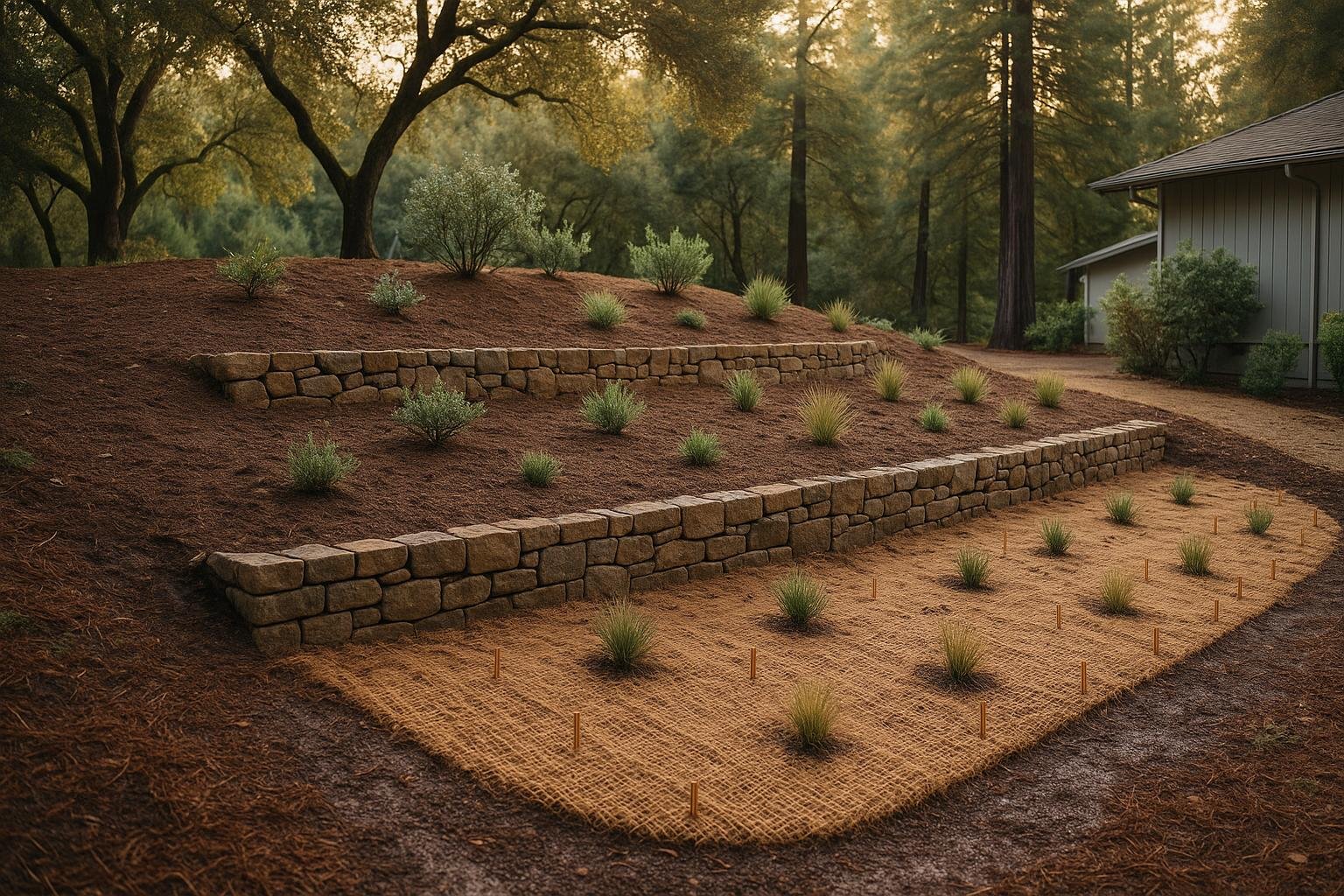
Terracing breaks a long slope into a stair-step of shorter, gentler benches. Each bench slows the water down, gives plants a flatter shelf to root into, and stops a small problem from snowballing into a big one.
We use terracing constantly in the mountain communities and on the steeper Aptos and Soquel hillsides. It looks like landscaping, not infrastructure, which most homeowners prefer over a single tall wall.
What makes a terrace actually hold:
- A real edge at each step, usually a low retaining wall, boulders, or pressure-treated timbers depending on the look
- Drainage behind every edge so water cannot build up pressure
- A slight back-slope on each bench so water flows away from the front edge instead of pouring over it
- Plants going in the same season, not next year
A two-foot terrace done right will hold longer than a six-foot wall done wrong.
When You Need a Retaining Wall
Sometimes a slope is too steep, too tall, or too close to a structure for planting and terracing alone. That is when a proper retaining wall earns its keep.
In Santa Cruz County, anything over four feet from the bottom of the footing to the top of the wall typically requires an engineered design and a permit. That number is not a suggestion. We have seen unpermitted tall walls fail in heavy winters, and the cost to rebuild plus regrade plus replant is far higher than doing it right the first time.
Block walls, segmental retaining wall systems, poured concrete, and engineered timber all work in our area. The choice usually comes down to height, soil conditions, aesthetics, and budget. What does not change is what goes behind the wall. Drain rock, filter fabric, and a perforated drain line at the base of the wall are mandatory. Skipping the drainage is the single most common reason a tall wall starts to lean.
For more on how we approach walls and the rest of the structural side of the yard, our hardscape work is built around the same principle. Solve drainage first, then build.
Plants Are Half the Battle
Roots are the cheapest, longest-lasting reinforcement you can put in a slope. The right plant palette will outlast almost any hardscape, and it is part of what makes a fix actually look like landscaping instead of a construction project.
A few categories we lean on for Santa Cruz slopes:
- Deep-rooted California natives like coffeeberry, toyon, ceanothus, manzanita, and coast live oak where there is room
- Spreading groundcovers like ceanothus 'Yankee Point', baccharis 'Pigeon Point', and creeping rosemary for fast coverage
- Tough ornamental grasses like deer grass and California fescue that knit the top inches of soil together
- A coir or jute erosion control blanket pinned over fresh plantings to hold soil while roots establish
Most of these are also good fits for drought tolerant designs, which matters because slopes are usually the hardest part of a yard to irrigate efficiently. The first two winters after planting are the make-or-break window. We typically run temporary drip irrigation through that period, then back it off as plants take hold.
A bare slope can also be hydroseeded with a native erosion-control mix. It is not a miracle, but it gets cover on bare ground fast, which is sometimes exactly what a slope needs heading into winter.
Fire-Scarred Slopes Need a Different Plan
If your lot was in or near the CZU footprint, the slope you are looking at probably lost its understory and a chunk of its root mass. Bare ground above a structure is a real risk every winter until cover comes back.
What we do on these lots usually includes hand-removing burned debris that is shedding ash and sediment, stabilizing the surface with a heavy erosion-control blanket or wattles laid on contour, replanting with a mix of fast cover and longer-term deep-rooted species, and keeping irrigation on long enough to establish. Going slowly is fine. Going slowly with a blanket on the ground is much better than going fast with bare soil.
On steeper post-fire slopes, especially in Boulder Creek and Ben Lomond, we sometimes pair planting work with low check dams in drainages, or short terraces where erosion has already cut a channel.
What It Costs and How Long It Takes
Erosion control work covers a huge range. A planting-and-blanket job on a moderate slope is on the lower end of the range, and we can usually get one done in a few days. An engineered tall wall with full drainage and replanting is on the higher end and may take a few weeks once the design and permit are squared away. We are happy to give a rough range, varies by site, after we walk it with you.
Timing matters too. The best window to do most of this work is late summer through early fall, so plants have a chance to root before the rain hits. If you are looking at a slope in October wondering if you can wait, do not wait. We can almost always at least get blankets and wattles in before the first big storm.
Frequently Asked Questions
Do I need a permit for erosion control work?
Most surface planting, swale work, and short terraces under three feet do not require a permit. Anything that involves a retaining wall over four feet, work near a creek or steep ravine, or grading that changes drainage onto a neighbor often does. We handle the permit conversation up front so it is not a surprise.
Will plants alone hold my slope?
On a gentle to moderate slope with the right species and time to establish, often yes. On a steep cut or anything close to a structure, plants are a critical layer but not the whole answer. Roots take a season or two to do their job, so pair planting with temporary erosion blankets or wattles.
How long until a new planting actually stabilizes a slope?
You will see meaningful root structure by the end of the first wet season, and full establishment usually by the end of the second. We design slopes assuming the first two winters are the riskiest, then they get better every year.
Can I just put down a tarp until I figure out what to do?
A tarp will get you through one storm, maybe two. After that it traps moisture against the soil, kills off any remaining vegetation underneath, and tends to slide. Coir or jute blankets pinned with biodegradable stakes work much better and let plants grow through.
Get a Free Estimate
PGS Landscape has been holding hillsides together across Santa Cruz County for 40 years, from coastal lots to deep mountain properties. If a slope on your property is starting to talk to you, walking it before the next storm is the smartest thing you can do. Call us at 831.254.3447 or reach out through our contact page and we will come take a look.