




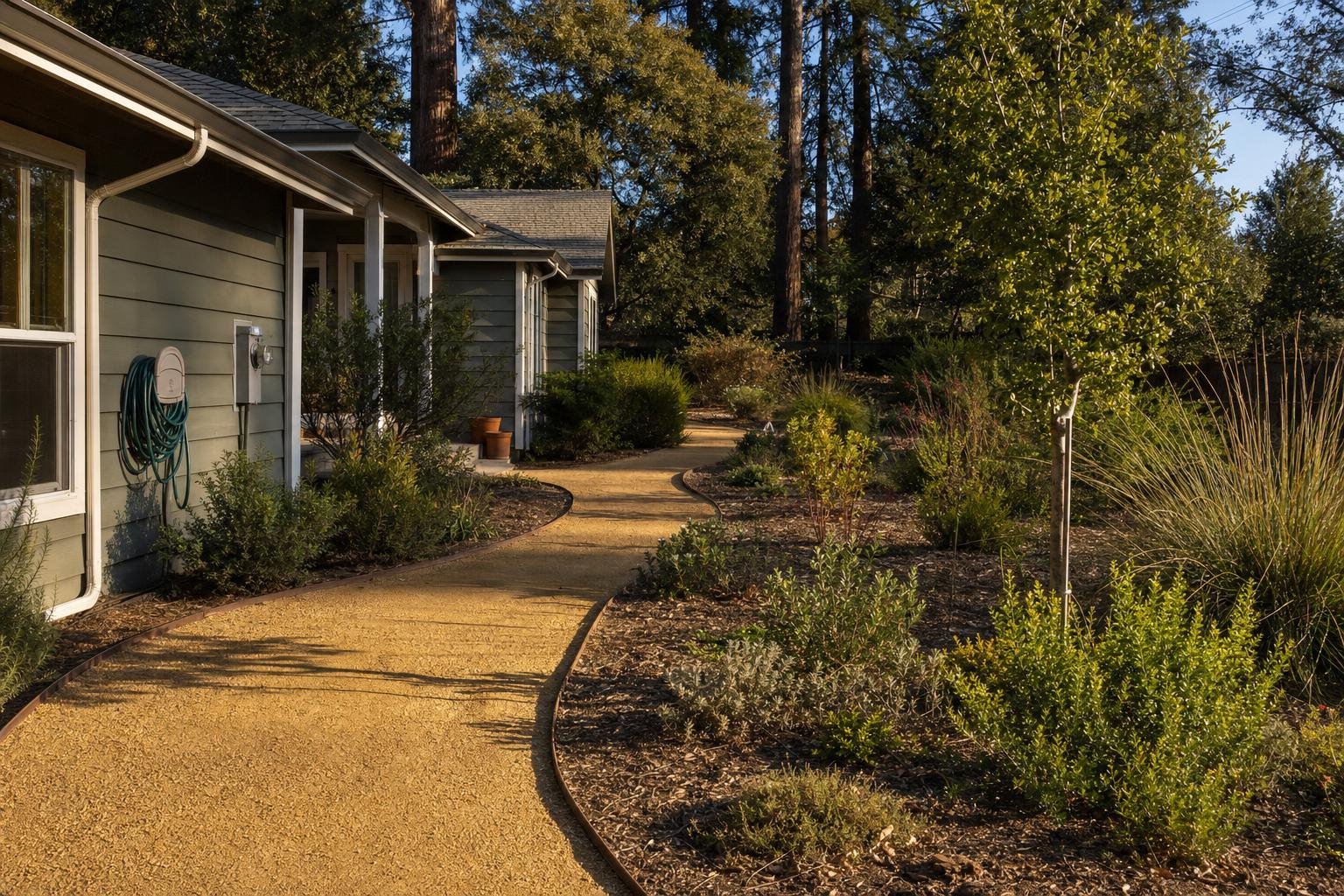
Decomposed granite is the surface most people picture when they think of a garden path. Warm gold color, soft underfoot, easy to curve around a tree. It is also the surface most likely to end up in a flower bed by February. What holds a DG path together is the work under it and the hard edge around it.
What Decomposed Granite Actually Is
DG is granite that has weathered in place until it crumbles. Screened for landscape use it comes out as a graded mix of angular sand and fines down to rock flour. The fines pack into the voids between the coarse grains, so once it is dampened and compacted the material locks up firm. Sand or single size gravel never does this, because nothing fills the gaps. Color runs gold, tan, gray, or reddish brown by quarry.
Stabilized or Loose
Two ways to finish a DG path, and they behave nothing alike.
Loose DG is the material compacted on its own. It drains freely and repairs easily. It also moves. Foot traffic, dogs, and rain push grains around, and some of it rides into the house on shoes.
Stabilized DG has a binder mixed through it before compaction, either a plant based resin or a small percentage of portland cement. Compacted damp at the right rate, the binder ties the fines together into a surface that sheds water and takes a loaded wheelbarrow without rutting. A resin stabilized path stays largely permeable. Cement stabilized DG is firmer still, though it behaves closer to a hard surface and a patch in it is harder to hide.
We usually recommend stabilized DG for a path that is a real route to a door, and loose DG for garden paths where the informal look matters more.
Base Preparation and Depth
We strip the organic topsoil, shape the subgrade to the finished contour, and compact it before any granite goes down. On firm soil a foot path is generally three to four inches of DG in two lifts. Where the soil is soft, or the path has to carry a garden cart, we lay a compacted aggregate base first and run the DG as a wearing course on top. Each lift gets watered close to the moisture content where it compacts best, then plate compacted. Dry DG will not compact. It shuffles under the plate and looks finished while staying loose.
Edging Keeps the Path Where You Put It
Granite at the edge of a path has nothing holding it, so it leaves. Every DG path we build gets a hard edge in steel, concrete, stone, or bender board, set just proud of the surface so the compacted material has something to press against. Near the water in Live Oak, Capitola, and Pacific Grove, thin uncoated steel rusts through fast in the salt air, so we specify a heavier coated gauge.
Drainage and Slope
This is where DG paths fail around Monterey Bay. Our rain arrives in concentrated multi day storms, and a path running straight down a slope turns into a channel. Moving water carries off the fines first, leaving a loose gravelly surface that will not compact again. So we crown or cross pitch the path to shed water sideways, keep the running slope gentle, break long descending runs with steps or a stone landing, and route downspout discharge clear of the path. On a steep lot in Felton, Boulder Creek, or Bonny Doon, stone steps with DG landings outlast a continuous run.
Firmness and Access
The ADA Accessibility Standards require ground surfaces on an accessible route to be "stable, firm, and slip-resistant" under section 302.1. Loose DG does not meet that. Properly stabilized and compacted DG can, which is why it shows up on park and campus paths. A private garden path is not held to the standard, but if anyone in the house uses a cane, a walker, or a wheelchair, build to it anyway at a width that fits the equipment.
Maintenance and Topping Up
A DG path is not maintenance free. Expect to top dress every few years: fresh material over the worn spots, wet it down, recompact. Loose paths need it sooner than stabilized ones. Weed seed germinates readily in the fines, so keep the surface raked clear of leaf litter, which breaks down into the soil weeds want.
Honest Tradeoffs Against Flagstone and Pavers
DG costs less to install, it drains, and it flexes over coast live oak and redwood roots that would crack a rigid slab. It is the wrong pick where patio furniture needs to sit level, where tracked grit next to a light floor would drive you crazy, or where the grade is steep. Flagstone and pavers hold their shape, carry vehicles, and lift and reset cleanly. Plenty of yards use both: DG through the garden, stone or pavers where the path meets the house. Our walkway and pathway page covers every material we build in, plus the permit thresholds for paths here.
DG Pathway Installation Across Santa Cruz County & Monterey County
PGS Landscape has been building paths around the Monterey Bay for over 40 years. We serve Santa Cruz, Aptos, Capitola, Scotts Valley, Soquel, Live Oak, Felton, Boulder Creek, Bonny Doon, Watsonville, Monterey, Carmel, Salinas, Pacific Grove, Marina, Seaside, and surrounding communities. A DG path can tie into a new patio, run along a retaining wall, or reach a fire pit, with edging and low voltage path lighting built into the same hardscape job.
Thinking about a decomposed granite path, or trying to fix one that keeps washing out? Call us at 831.254.3447 for a free estimate, or contact us online.