




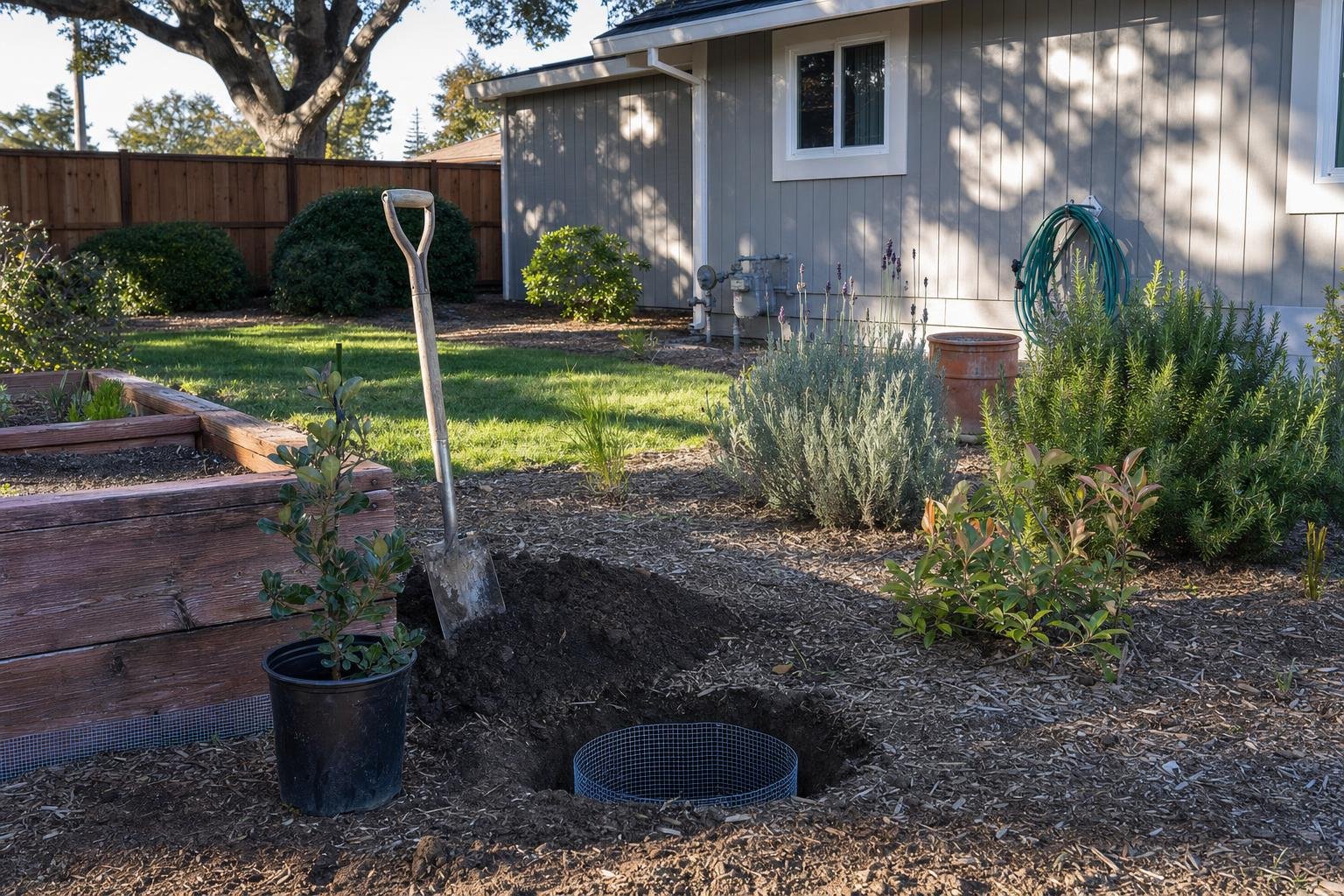
Almost every yard we work on in Santa Cruz County has gophers, or had them, or will. Trappers can clear the ones you have. What we can do is build the lawn, the beds, and the plantings so the next gopher can't get at them. That work happens once, while the ground is open.
Why your yard is the best spot on the block
Gophers go where the food is soft and the digging is easy. A watered lawn or vegetable bed in the middle of a dry summer is both. UC's pest note on pocket gophers says gophers on unirrigated ground usually raise one litter a year, while on irrigated sites they can raise up to three. Your sprinklers are part of the reason the population keeps coming back.
The same note says one gopher usually lives alone, in a burrow system covering anywhere from 200 to 2,000 square feet. So a fresh line of mounds across a small yard often means a single animal. Clear it out and the empty tunnels sit there for the next one. That happens fast if you back onto open space, a creek, or farm fields, which describes a lot of this county from the Westside greenbelt to the Watsonville side.
First, make sure it's a gopher. A gopher mound is crescent or horseshoe shaped with the plugged hole off to one side. A mole mound is rounder, like a little volcano, with the plug in the middle. Moles eat grubs and worms, not roots, and the fix is different.
Where the wire goes
Wire only goes in during construction. Nobody can slide it under a lawn that's already there.
Under a new lawn
When we put in a new sod lawn, gopher wire is part of the job on most properties. The ground gets graded and amended, the wire gets rolled out and overlapped at the seams, and the edges get turned down along the borders so gophers can't come in from the side. Then a shallow layer of soil goes on top and the sod goes over that.
Depth is where people go wrong. Bury the wire too deep and gophers will tunnel in the gap between the wire and the sod and chew the roots anyway. It should sit just below the sod's root zone, close enough that there's no room for a tunnel. Timing matters too. Our post on when to plant a lawn in Santa Cruz covers the planting windows, and the wire has to go in on the same day as the rest of the prep.
Under raised beds
UC's advice here is simple: when you build a raised bed, lay mesh wire under the soil. We run it across the whole bottom and up the inside of the boards a few inches, then fasten it so there's no gap at the corners. Use a proper galvanized or stainless gopher wire, not chicken wire. Chicken wire rusts out in a few seasons and then you're back where you started, with a full bed of soil sitting on top of the hole.
Around trees and shrubs
Individual plants go in wire baskets, and UC recommends light gauge, non galvanized wire for baskets, on purpose. It rusts away after several years, so the roots of a growing tree or shrub don't get strangled by the cage. The basket protects a young plant through the years when a gopher can kill it outright, then gets out of the way, which is why we use galvanized wire under lawns and beds but never for a tree basket.
Around the irrigation
Gophers chew plastic water lines, and UC says drip tubing is the kind they go after most. On a new install we route lines where they can be reached, and where gophers are bad we protect them. UC's pest note suggests a surround of coarse gravel, six to eight inches of it, around buried flexible lines. If your drip keeps springing mystery leaks, our drip irrigation post covers how to spot rodent damage, and our irrigation systems page covers laying out a system that's easy to repair.
Along a property line
On a big lot next to open land, a buried wire barrier along the fence line can cut down on gophers coming in from outside. UC describes burying mesh at least two feet deep with an extra six inches bent outward at the bottom, and leaving a foot above ground. It's a real project and it isn't right for every yard. We save it for the edges where new gophers keep showing up.
What doesn't work
People ask us about these on almost every job, and none of them hold up.
- Vibrating stakes, ultrasonic spikes, and pinwheels. UC says none of them were effective in research trials.
- "Gopher repellent" plants like gopher purge, castor bean, and garlic. None of them has been shown to keep gophers out of an area.
- Smoke bombs. Gophers seal off the burrow faster than the smoke spreads.
- Counting on owls. Barn owls do eat gophers, but they hunt over too much ground to protect one yard.
- Bait from the hardware store. Rules in California have tightened, and UC's pest note says several of the older baits are no longer legal for home use. Poison in the ground is also a risk to pets and wildlife that catch a sick gopher.
Trapping does work. If you already have gophers, call a good local trapper, then let the wire protect whatever you build next.
Plants that hold up better
Some plants get left alone more than others. Lavender, rosemary, and salvia rarely get hit, and many of the drought tolerant natives we plant in fall are tough enough to handle some root damage. None of that is a guarantee. For anything you'd hate to lose, like a young fruit tree, a hedge you waited years on, or a vegetable bed, use wire and don't count on the plant.
Frequently Asked Questions
Can you put gopher wire under an existing lawn?
No. The wire has to go under the sod, so the lawn comes up first. If you're thinking about replacing a tired lawn anyway, that's the time to do it.
Do gopher baskets hurt the roots?
Not if you use the right ones. Light gauge, non galvanized baskets break down over several years, so the roots can grow out once the plant is past the vulnerable stage.
Is gopher wire worth it for artificial turf?
Yes on most properties. Gophers can push mounds up under synthetic turf and leave lumps in it, and wire under the base stops that. We cover it on our turf installs the same way we do for sod.
Get a Free Estimate
PGS has been building lawns, beds, and gardens in Santa Cruz and Monterey County for over 40 years, and we've put gopher wire under more of them than we could count. If you're planning a new lawn or garden and want it built to keep gophers out, call 831.254.3447 or reach us through our contact page.