




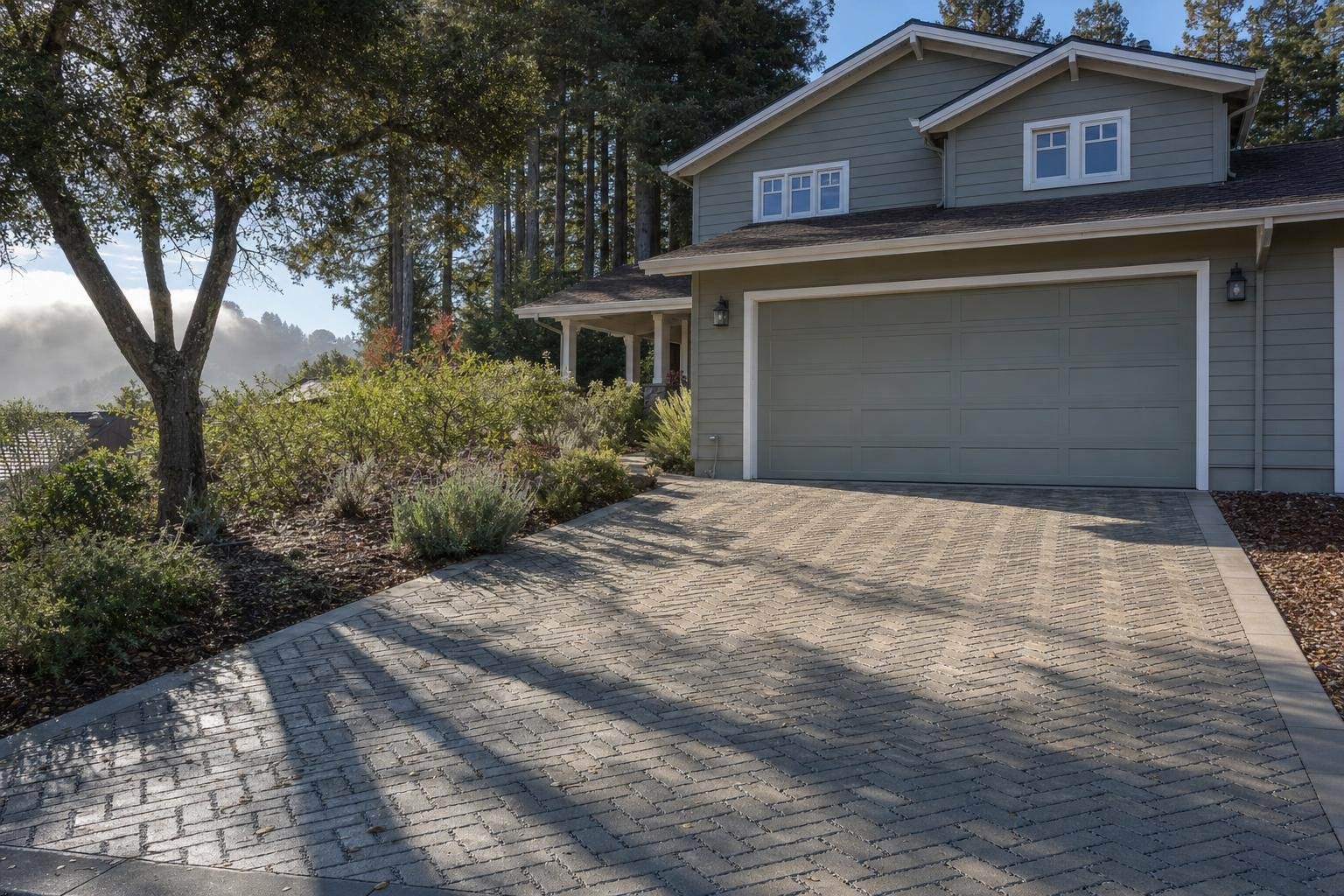
More people are asking us about permeable pavers, usually after a wet winter sent water down the driveway and into the garage or the street. A permeable driveway lets rain soak through the surface into the ground. It works very well on some lots here and needs extra thought on others.
How a permeable paver driveway is built
A regular paver driveway sits on dense, compacted base rock and a layer of sand, with fine sand packed into the joints. Water runs off it. A permeable driveway uses pavers with wider joints, and those joints get filled with small crushed stone instead of sand. Under the pavers is a deep bed of clean, washed crushed rock with no fines in it, so there are open spaces between the stones. Rain drops through the joints, fills those spaces, and then soaks into the soil below at whatever pace the soil allows.
That rock bed is deeper than a standard driveway base, because it has to do two jobs. It carries the weight of the cars, and it holds water while the ground catches up.
Will it drain on your soil?
This decides most of it, and the answer changes from one side of the county to the other.
Down near the coast, a lot of Live Oak, Capitola, Aptos, and La Selva Beach sits on sandy soil that drains fast. Permeable pavers are a great fit there.
Clay is a different story. Much of Scotts Valley, Watsonville, Corralitos, and the hills behind Aptos have heavy clay that takes in water very slowly. A permeable driveway on clay still works, but we build it differently. The rock bed gets deeper so it can hold more water, and we usually add a perforated pipe near the bottom that carries the overflow to a planting bed or a dry creek where it can soak in. Without that, the base can sit wet all winter, and a base that stays soaked is what lets pavers settle.
Before we commit to a design, we dig a test hole, fill it with water, and see how fast it drains.
Where we'd think twice
A few situations change the plan:
- On a steep driveway in Boulder Creek or Bonny Doon, water in the rock bed runs downhill underneath the pavers and comes out at the bottom. We can break the base into level steps with buried dams, but on very steep runs a solid surface with good drainage at the edges is often the better call. Our pavers vs concrete post covers steep driveways.
- Next to the house, we don't want water soaking in against a foundation or a crawl space. There we either line that part of the base or slope it away.
- On a septic property, we check where the leach field sits before we plan anything that sends more water into the ground near it.
- Under redwoods and oaks, needles and leaves are the main thing that clogs permeable joints. It still works under trees, it just needs more upkeep.
Upkeep is the part people skip
A permeable driveway only works as long as the joints stay open. Over the years, dirt, leaves, and needles get ground into the stone chips and the water starts sitting on top instead of going through.
What keeps it working:
- Blow or sweep off leaves and needles regularly, especially in fall.
- Once a year or so, have the joints cleaned out with a vacuum sweeper, or pull out the top of the dirty chips by hand on a small driveway.
- Top up the joint stone after cleaning so the pavers stay locked together.
- Don't let landscape mulch or soil wash onto the driveway.
If water starts puddling on the surface after a storm, that's the joints telling you they need cleaning. Let it go for years and the fix can mean pulling up pavers to clean the base.
The county stormwater rules
Going permeable doesn't take a driveway out of the county's stormwater review. In the unincorporated county, the Public Works building permit guidance covers new and replaced semi-pervious surfaces along with solid ones, and the requirements step up at 500 square feet and again at 5,000. A permeable surface can still make the drainage side easier to meet, because more water stays on your lot. Inside city limits, check with the City of Santa Cruz, Capitola, Scotts Valley, or Watsonville, since each one has its own rules.
For homeowners who want to understand their drainage before deciding anything, the Resource Conservation District of Santa Cruz County offers free drainage and erosion consultations, and its "Slow it, Spread it, Sink it!" homeowner guide lists pervious pavers among the options.
Other ways to get there
A full permeable paver driveway isn't the only way to let rain soak in. We also build these:
- A ribbon driveway, which is two paved strips for the tires and gravel or low plants down the middle. It has less pavement and an older look that suits a lot of Santa Cruz houses.
- Gravel or decomposed granite, which drains on its own but ruts on slopes and tracks into the house. Our decomposed granite page covers how we build it to last.
- A standard paver or concrete driveway with a band of permeable pavers or a gravel trench along the low edge to catch the runoff.
Whatever material you pick, the goal is the same as any driveway we build: water moves away from the house and soaks into the ground instead of heading for the street.
Frequently Asked Questions
Do permeable pavers work on clay soil?
Yes, but they need a deeper rock base and usually a perforated pipe to carry overflow to a spot where it can soak in. We test how fast your soil drains before designing one.
How long does a permeable paver driveway last?
Built on a proper base and kept clean, it should last as long as a regular paver driveway. The joints are what wear out first, and cleaning and refilling them keeps the whole system working.
Do I need a permit for a permeable driveway in Santa Cruz County?
It depends on the size and the rest of the project. The county reviews new and replaced semi-pervious surfaces along with solid ones, so check the Public Works guidance or ask us early.
Can I drive a truck on permeable pavers?
Yes. Built with a driveway-grade paver and a full depth rock base, it carries cars and trucks like any other paver driveway.
Get a Free Estimate
We've been building driveways and handling drainage in Santa Cruz County for over 40 years, on sand, on clay, and on some very steep hills. If you're thinking about a permeable driveway, call us at 831.254.3447 or reach out through our contact page and we'll come take a look at your soil and your slope.