




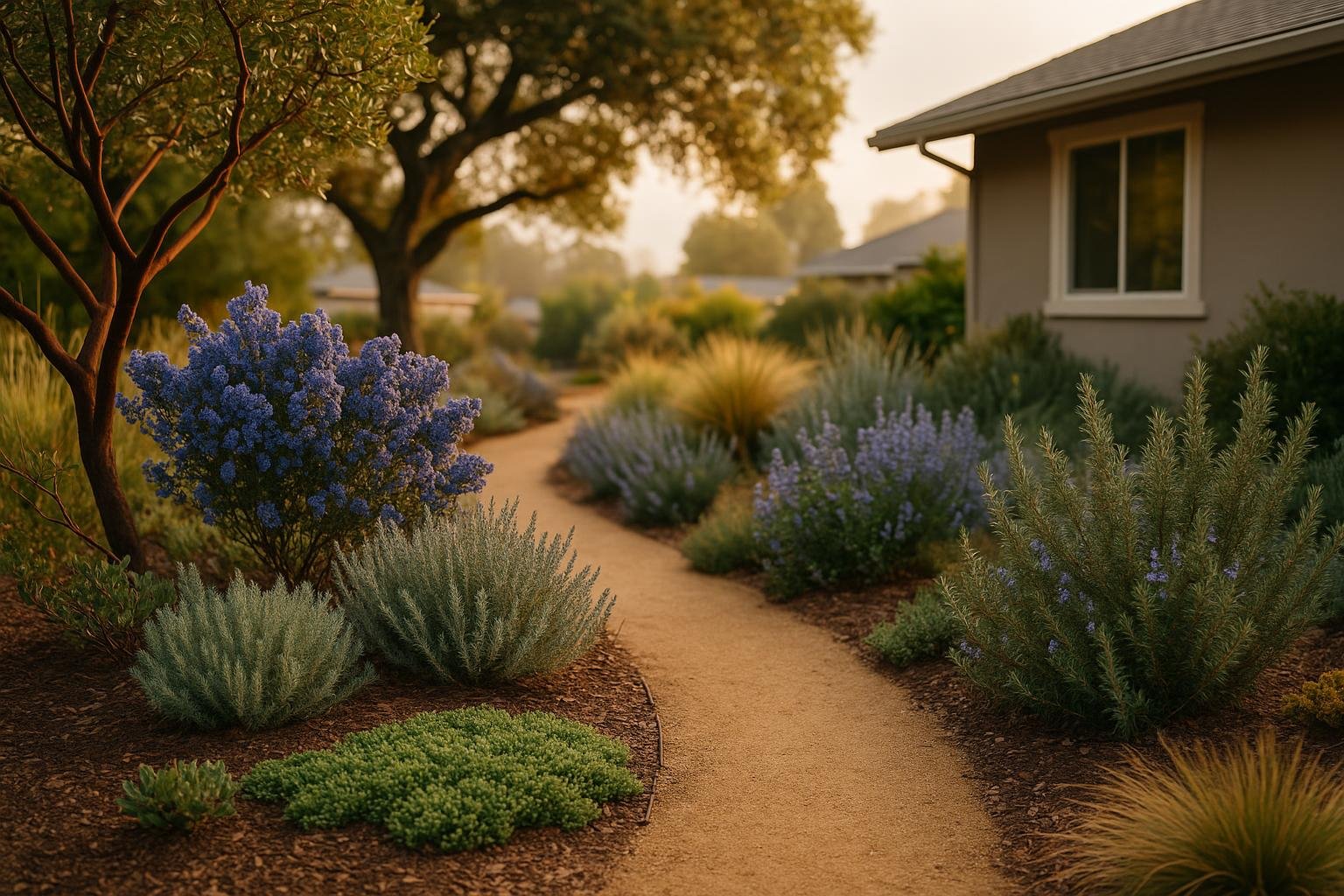
After 40 years of planting in Santa Cruz County, here is the list we actually use. Not a Pinterest board. The plants below survive our long dry summers, wet winters, coastal salt fog, mountain clay, and in most cases, the deer. If you live anywhere from Davenport down to Watsonville, or up into Boulder Creek, this should give you a working starting point for a yard that looks alive without running the sprinklers every other day.
What "drought tolerant" actually means in Santa Cruz
A drought tolerant plant holds its own through our dry stretch from May through October without extra water once established. Established usually means the first one to two years in the ground, where you do water regularly. After that, most get by on winter rain plus an occasional deep soak.
Two local notes. First, the City of Santa Cruz and the Soquel Creek Water District both run conservation programs around lawn conversions, smart controllers, and graywater. Check with your water provider before tearing out a lawn. The rebate can offset a real chunk of the work.
Second, Santa Cruz County is not one climate. A plant list for a sunny Live Oak front yard is not the same as a redwood-shaded lot in Felton or a windy bluff in Pacific Grove. We break it out below.
Drought tolerant plants for sunny coastal and inland yards
These are the workhorses for full-sun yards in Santa Cruz, Capitola, Aptos, Soquel, La Selva Beach, Watsonville, and the warmer Live Oak and Pasatiempo neighborhoods. Most are California natives or Mediterranean climate plants that thrive on our rain pattern.
- Manzanita (Arctostaphylos). Evergreen, red bark, bell flowers in late winter. Howard McMinn is our most reliable variety. Slow to establish, then bulletproof.
- California lilac (Ceanothus). Blue-flowering shrub the bees love. Concha and Dark Star handle clay better than most.
- Coffeeberry (Frangula californica). Tough, deer-resistant evergreen shrub. Eve Case is the compact variety we plant most.
- Toyon (Heteromeles arbutifolia). Native evergreen, red berries in winter, deer largely leave it alone.
- California fuchsia (Epilobium canum). Late-summer red flowers when nothing else is blooming. Hummingbird magnet.
- Salvias. Bee's Bliss, Winnifred Gilman, and Black-and-Blue all do well in a sunny spot with sharp drainage.
- Lavender (Lavandula). Provence and Goodwin Creek hold up best in our humidity. Cut hard after bloom.
- Rosemary (Salvia rosmarinus). Tuscan Blue upright for hedges, Prostratus for spilling over a wall.
- Westringia (Westringia fruticosa). Coastal rosemary lookalike. Takes salt wind, shears nicely, no deer interest.
Plants for the shade, redwood and oak yards
Drought tolerant in shade is a different problem. You are usually fighting root competition from redwoods or oaks, plus dry shade in summer. These hold up in Felton, Boulder Creek, Ben Lomond, Scotts Valley, and the shaded sides of homes throughout the county.
- Coral bells (Heuchera). Native varieties like Heuchera maxima and Wendy do well under oaks.
- Western sword fern (Polystichum munitum). Evergreen, classic redwood understory.
- Douglas iris (Iris douglasiana). Spring color in dry shade. Spreads slowly into a clump.
- California huckleberry (Vaccinium ovatum). Slow but stunning evergreen shrub for shade. Edible berries.
- Salal (Gaultheria shallon). Tough evergreen groundcover for shade.
- Wood strawberry (Fragaria vesca). Native groundcover, knits in over time.
Plants for windy bluffs and salt fog
Pacific Grove, Marina, Seaside, the open lots out near Davenport, and anything on West Cliff or East Cliff above the ocean. Salt and wind kill more plants here than drought does.
- Coast rosemary (Westringia). See above. We plant a lot of this.
- California sagebrush (Artemisia californica). Silver foliage, salt tolerant, deer ignore it.
- Yarrow (Achillea millefolium). Native, takes wind, blooms summer.
- Lupines, native annual and perennial varieties. Self-seed nicely on coastal lots.
- New Zealand flax (Phormium). Not native, but holds up to salt wind better than almost anything. Use as accent, not a hedge.
Deer resistant choices for the mountains
If you are in Bonny Doon, Boulder Creek, the upper end of Soquel, or anywhere with a real deer population, your plant list narrows fast. We have seen deer eat plants the books say they will not touch. That said, these have held up over many jobs.
- Salvias (most varieties)
- Lavender, rosemary, sage
- Manzanita, coffeeberry, toyon
- Yarrow, California fuchsia
- Mexican feather grass (Stipa tenuissima)
Pair drought tolerant planting with good irrigation and a smart controller. Drip on a weather-based controller cuts your summer water use dramatically while giving the plants a clean shot of water at the root zone. If you are doing a whole-yard conversion, see our drought tolerant landscape page for how we approach the full job, and the broader drought page for water-saving design ideas beyond plant choice.
Getting plants established
A drought tolerant plant that is not watered in its first summer is just a dead plant. A few hard-earned tips.
- Plant in fall. October through December is the window. Roots grow over the wet winter so the plant is ready for our dry summer.
- Water deep, not often. A deep soak every 7 to 14 days for the first summer beats a daily sprinkle every time.
- Mulch 3 inches deep. Holds soil moisture, suppresses weeds, moderates soil temperature.
- Skip the fertilizer. Most California natives resent rich soil. Plant in native dirt, mulch on top.
Frequently Asked Questions
Are drought tolerant plants more expensive?
Plant cost is similar to any landscape shrub. The savings come on the back end through lower water bills, less irrigation hardware, and lower maintenance over the life of the yard.
Can I plant drought tolerant in spring or summer?
You can, but you will be on the hose for the first season. Fall planting is much easier on the plant and on you.
Do I still need irrigation?
Yes, at least for the first one to two years while plants establish. After that, a drip system on a smart controller can run very lightly, just enough to keep things looking their best through the longest dry stretches.
What about lawns?
A traditional lawn is the single biggest water user in most yards. If you want lawn, look at low-water grasses or synthetic turf for play areas, and keep the rest of the yard in drought tolerant planting.
Will deer leave these plants alone?
Most of the plants on the deer-resistant list have held up for us in real Santa Cruz Mountains yards. No plant is truly deer-proof in a drought year when food is short.
Get a Free Estimate
PGS Landscape has been planting yards across Santa Cruz County for more than 40 years. We know what survives, what thrives, and what is a waste of money on your particular lot. If you want help putting together a drought tolerant plant plan, or converting a thirsty yard into something that fits our climate, give us a call at 831.254.3447 or reach out through our contact page for a free estimate.