




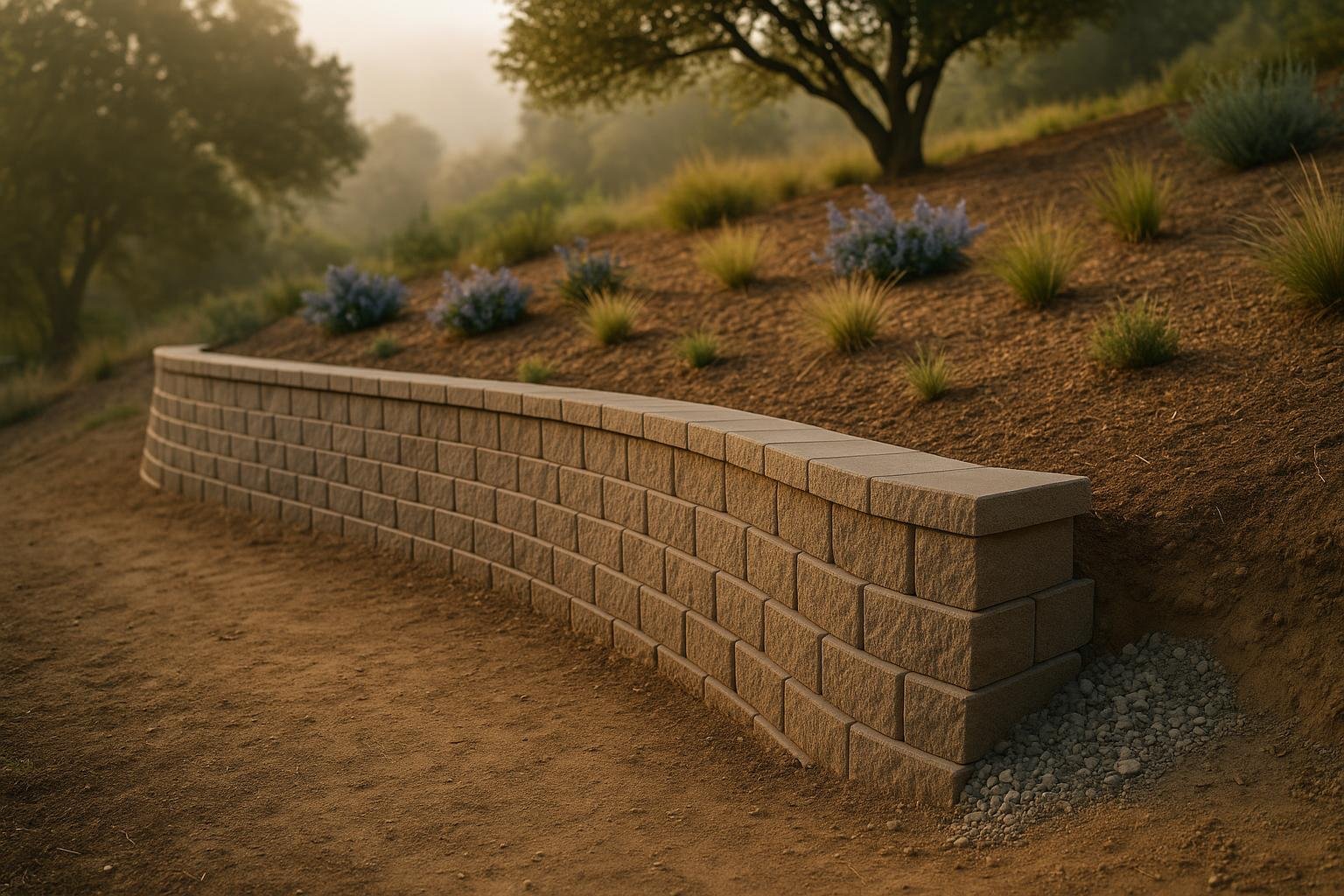
If you search retaining wall cost per foot in California, you will find numbers that swing so widely they are almost useless. We have built retaining walls on Santa Cruz and Monterey County hillsides for more than 40 years, and the honest answer is that the per-foot number depends on your site more than on any chart. This post explains what actually moves that number, so you can read a bid and know what you are paying for.
Why the Per-Foot Numbers Online Mislead
Most of the cost guides that rank for this search are national aggregators. They average a flat backyard in the Midwest together with a steep lot in the Santa Cruz Mountains, and the result fits neither.
Here is what those averages hide:
- Labor is usually half the job or more. California labor rates are not national labor rates, and hillside labor is not flat-yard labor.
- A "foot" of wall is not one thing. A linear foot of a two-foot garden border and a linear foot of a six-foot engineered wall are entirely different products.
- Site work is invisible in the averages. Excavation, haul-off, base rock, drainage, and access make up a large share of a real bid, and none of it shows up in a per-foot chart.
So instead of quoting a number, let us walk through what drives it. That is a conversation we have with homeowners every week.
Height Changes Everything, Especially at Four Feet
Cost per foot does not climb in a straight line as a wall gets taller. It jumps.
A short garden wall holds back a planting bed. A taller wall holds back the hillside itself, and the pressure behind a wall grows much faster than its height. Doubling the height of a wall far more than doubles the base, the footing, the reinforcement, and the drainage behind it.
In Santa Cruz County there is also a hard regulatory line. Walls four feet and taller require a building permit with structural engineering, submitted through the county's ePlan system. And here is the part that surprises people: even a shorter wall needs engineering if it carries a surcharge, meaning a driveway, a structure, or a slope pushing on it from above. We see this constantly on mountain lots in Boulder Creek, Ben Lomond, and Felton, where the wall sits below a parking pad.
Engineering, plans, and permit fees are real line items. They are not padding. A permitted, engineered wall is the one that is still standing after a wet winter.
Materials, and How Long Each One Actually Lasts
Material is the variable most people focus on, and it does matter, just not the way the comparison charts suggest. What we care about after 40 years on these jobs is lifespan per dollar, not the cheapest install.
- Pressure-treated timber. The lowest upfront cost and the shortest life. In our wet winters and on irrigated yards, timber walls commonly need replacement in 10 to 20 years. A lot of our work is tearing out failed timber walls someone paid for twice.
- Segmental concrete block. The workhorse. Interlocking block systems flex slightly in seismic movement, drain well when built right, and routinely last 40 years or more. This is what we recommend most often on residential slopes.
- Poured concrete. Very strong and clean-looking, with a long life when the footing and drainage are engineered correctly. Less forgiving of shortcuts, since a poured wall that cracks cannot be restacked.
- Natural stone. The premium look, and it suits older Santa Cruz neighborhoods and Carmel properties. Higher labor per foot because every stone is handled and fit.
If a bid seems dramatically cheaper than the others, the difference is usually buried in one of these choices, or in what is missing behind the wall.
What Else Moves the Number on a California Lot
Beyond height and material, these are the drivers we price on every local job:
- Access. If we can get a machine to the wall line, the job moves fast. If everything travels by wheelbarrow up a narrow side yard in Scotts Valley, labor hours climb.
- Drainage. Every real retaining wall needs gravel backfill, drain pipe, and a place to send the water. Most of the failed walls we replace died from water pressure, not from weak blocks. On slopes this ties directly into hillside erosion control.
- Soil. Mountain clay holds water and pushes hard when saturated. Sandy coastal soils drain but need wider bases. The soil report on an engineered wall exists for a reason.
- Demolition. Removing an old failed wall, and hauling it off a hillside, is its own project before the new wall starts.
- Terracing. Sometimes two shorter stepped walls beat one tall wall. They can stay under the engineering threshold, hold planting beds, and look better on a hardscape plan. Sometimes the slope will not allow it. This is a site call.
How to Budget Without a Per-Foot Guess
Rather than trusting a chart, think in tiers. A decorative garden wall under three feet is a modest project. A structural wall in the three-to-four-foot range with proper drainage is a mid-size investment. An engineered wall over four feet, or any wall with a driveway above it, is a serious construction project with design, permits, and inspections built in. Any real number is a rough range that varies by site, which is exactly why we look at the property before quoting anything.
The good news is that a properly built wall is one of the longest-lived things you can add to a yard. On slopes around Boulder Creek we have walls we installed decades ago that have not moved an inch.
Frequently Asked Questions
Do I need a permit for a retaining wall in Santa Cruz County?
Yes, if the wall is four feet or taller, and permits require engineered plans submitted through the county. Shorter walls also need engineering when a driveway, structure, or slope pushes on them from above.
What retaining wall material lasts the longest?
Properly drained segmental block and poured concrete walls routinely last 40 years or more. Timber is the shortest-lived option in our wet-winter climate.
Why is a taller wall so much more expensive per foot?
Soil pressure grows much faster than wall height, so a taller wall needs a bigger footing, more reinforcement, more drainage, and usually engineering. The cost per foot jumps rather than climbing gradually.
Why do retaining walls fail?
Water, almost every time. Walls built without gravel backfill and a drain pipe get pushed over by saturated soil, which is why drainage is never the place to cut a bid.
Get a Free Estimate
PGS Landscape has been building retaining walls across Santa Cruz and Monterey County for more than 40 years, from small garden terraces to fully engineered hillside walls. If you want a real number for your slope instead of an internet average, give us a call at 831.254.3447 or reach us through our contact page for a free estimate.