




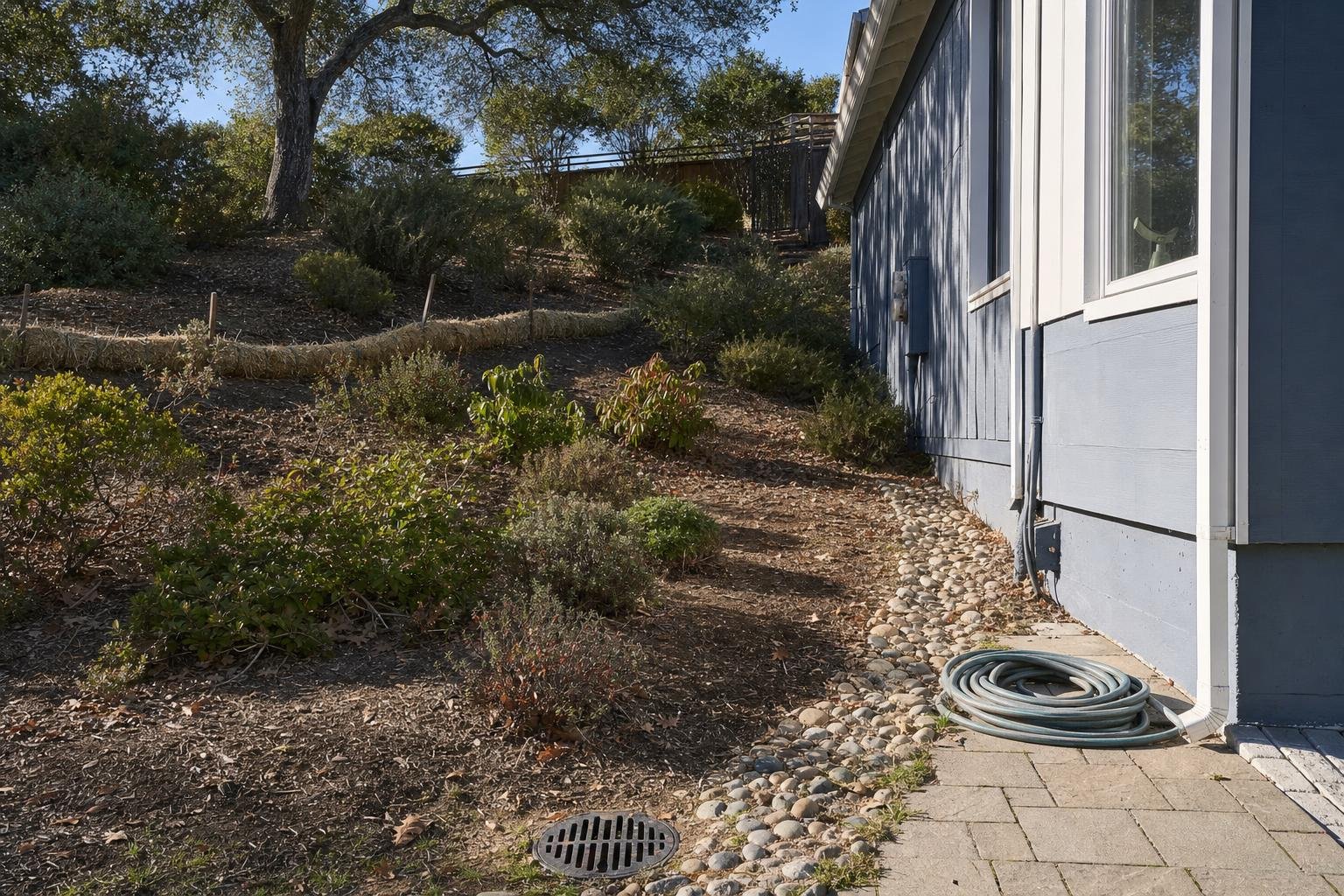
Around here the rain does not trickle in. Most of Santa Cruz County's rain falls between November and March, and one atmospheric river can drop more water in two days than we see all summer. If you want to prepare your yard for rainy season in Santa Cruz, the window is late summer through early fall, while the ground is still dry enough to dig and the trucks can still get up the driveway.
We have been doing this work in this county for more than 40 years. Every winter we get calls in the middle of a storm from people watching water run toward the house. Almost every one of those calls could have been a two-hour job in September.
Walk the property and figure out where the water goes
Before you buy a single thing, go outside and look at the ground. You are trying to answer one question. When water lands on this property, where does it end up?
Stand at the uphill corner and follow the natural fall of the land with your eyes. Look for the low spots that stayed green all summer, the bare dirt tracks where runoff has already carved a path, and any place where the soil sits higher than the base of the house. Water always goes downhill and it always takes the easiest route. Your job is to make the easiest route go somewhere useful.
Note the trouble spots on your phone. If you have had standing water in the same place two winters running, that is not bad luck. That is a grading problem or a drain problem, and it will be there again.
Clear every drain before the first storm
This is the cheapest work on the list and the one people skip.
- Clean the gutters and flush the downspouts with a hose. Redwood needles and oak leaves pack down into a mat that water will not move.
- Find where your downspouts actually discharge. A downspout dumping at the foundation is the single most common cause of a wet crawlspace we see.
- Run a hose into any underground drain line and watch for the outlet to flow. If water backs up at the inlet, the line is plugged or crushed.
- Pull the leaves off area drains and catch basin grates in the lawn and patio.
- On rural and mountain properties, check the driveway culvert and the roadside ditch. A blocked culvert sends the whole road down your driveway.
If you flush a line and nothing comes out the other end, deal with it now. Locating and clearing a buried line in October is straightforward work. Doing it in January, in the rain, with the yard turned to mud, is a different job. We wrote more about how we handle these systems in our post on yard drainage in Santa Cruz.
Slopes are the part that cannot wait
Santa Cruz County is full of sloped lots, and bare soil on a slope is what gets people in trouble. Once a rill starts cutting, every storm after that makes it deeper.
Get living cover on it. Deep-rooted plants hold soil at several depths and break up the rain before it hits bare ground. Fall is a good time to plant here because the soil is still warm and the winter rain does the watering for you.
For the season ahead, straw wattles laid across the slope on contour will slow water down and catch sediment while new plants root in. Erosion netting and a good layer of mulch help on the steeper faces. If your slope is already moving, or you are looking at a cut bank that keeps shedding material, that is a structural problem and wattles will not fix it. See our notes on hillside erosion control, and on when a retaining wall is the honest answer.
If your property sits in or below an old burn scar, treat slope work as the priority and get it done early. Ground that lost its cover sheds a lot more water and a lot more sediment than it used to.
Turn the irrigation down before you forget
Nothing looks worse than sprinklers running in a rainstorm, and every fall we drive past somebody doing it.
Put the controller on its winter schedule or shut the program off entirely once the rain starts. If you have a rain sensor, test it. If you do not have one, adding a rain sensor or a weather-based controller to your existing irrigation system is a small job in the fall and it pays for itself in water you do not waste. While you are at it, run each zone once and watch for the leaks and broken heads that hid behind summer growth.
Two local things most people miss
Santa Cruz County publishes sandbag pickup locations for unincorporated areas each winter, with a limit of 15 bags per resident and no contractors. City residents have their own pickup spots. Get them before the forecast turns, not the morning of.
The county also points homeowners to the Resource Conservation District of Santa Cruz County, which offers a free on-site property erosion and drainage assessment. If you have a slope you are unsure about, that is a good free set of eyes to have on it before you spend money.
Frequently Asked Questions
When should I start getting my yard ready for the rainy season?
September through mid-October is the sweet spot. The ground is still workable, plants have time to root before the heavy rain, and you are ahead of the crews that get booked solid the week of the first storm.
Do I need to shut my sprinklers off completely for the winter?
Usually yes, once the rain is steady. We rarely get hard freezes on the coast, so blowing out lines is not the concern it is inland. The concern is wasting water and drowning plants that are already sitting in saturated soil.
Will a fresh layer of mulch just wash away?
Not if you use the right material and keep it off the steepest ground. Coarse arbor chips knit together and stay put far better than fine bark. On steep faces, netting or wattles hold the mulch until plants take over.
Can I still do this work after the rain starts?
Some of it, yes. Clearing drains and gutters can happen any time. Grading, planting, and anything that needs equipment on the property gets harder and more expensive once the soil is wet, and on some sites it stops being possible at all.
Get a Free Estimate
PGS Landscape has been working on yards around Santa Cruz, Scotts Valley, Soquel, and the mountain towns for more than 40 years, and we have seen what these winters do to a property that was not ready. If you want somebody to walk your drainage and your slopes before the first storm, give us a call at 831.254.3447 or contact us online for a free estimate.