




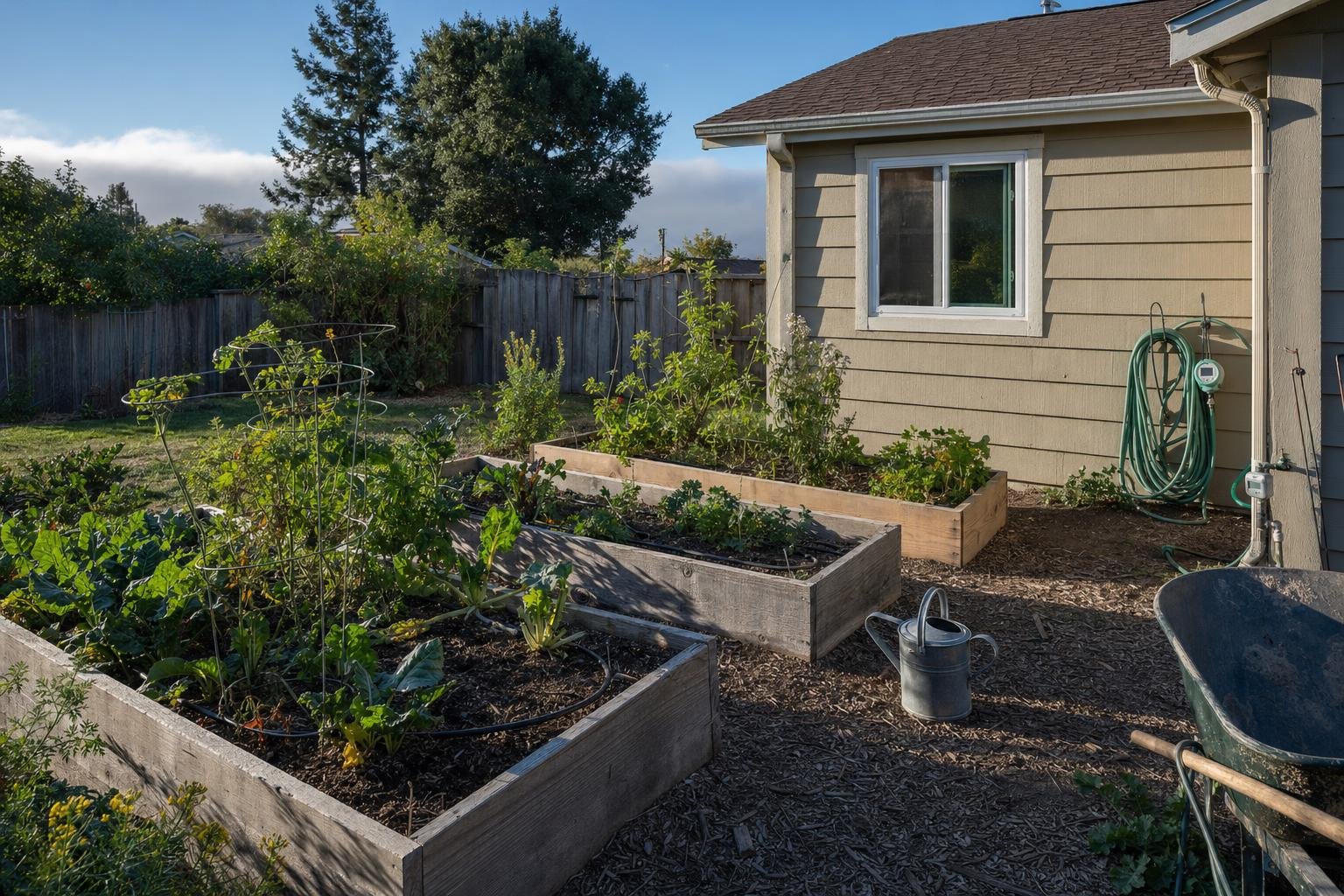
People ask us about drip in the food garden more than almost anything else. A vegetable bed is unforgiving in a way an ornamental bed is not. Water a salvia unevenly and it shrugs. Water tomatoes unevenly and you get split fruit and blossom end rot, and you find that out in August after the season is already spent.
Drip beats soaker hose and spray for edibles
Overhead spray is the worst option. It wets the leaves, and wet foliage overnight in our climate is how powdery mildew gets going on squash, beans, and brassicas. It also waters the paths between your beds as thoroughly as the beds themselves, which is free irrigation for weeds.
Soaker hose is cheap and a real improvement, but its output is uneven along its length and gets worse as the pores clog with age. Fine in one short raised bed. Across a 40 foot garden it quietly starves one end.
Drip with pressure compensating emitters fixes the evenness directly. Those emitters put out the same flow across a range of pressures, so the far end of the line gets what the near end gets, and the UC Master Gardener Program of Sonoma County notes they clog less than the cheaper kind. Their drip irrigation basics page walks through the parts.
Emitter spacing and flow, rows versus raised beds
Inline drip tubing, the kind with emitters built into the line at the factory, comes in a few standard spacings. UC lists 12, 18, and 24 inches. Which one you want depends on your soil more than on your crop, because water does not go straight down. It spreads sideways as it soaks in, narrow in sand and wide in clay. Sandy ground under a 24 inch spacing leaves dry gaps between plants where the wet patches never join up.
Roughly how we lay it out:
- Raised beds three or four feet wide: two or three runs of half inch inline tubing down the length of the bed, 12 inch emitter spacing, lines about a foot apart. Quarter inch inline tubing works in beds too and is easier to snake around.
- In ground rows: one line per row for anything planted in a single line, two for a wide row or a block planting. Sandy ground wants the 12 inch spacing. Heavier soil can go to 18.
- Big single plants: tomatoes, squash, and artichokes do better with a ring of quarter inch line around the plant than with one emitter sitting against the stem.
Emitter flow is usually half a gallon, one gallon, or two gallons per hour. For vegetables, lower flow over a longer run beats high flow over a short one, because the soil gets time to take the water in instead of shedding it.
Check your drainage first. The UC Master Gardeners covering our counties describe a percolation test in their article on what to know about watering: dig a hole about a foot each way, soak it, refill it, and see how far the water drops in 15 minutes. Under an inch per hour is poor. Over four is excessive. Either one changes your run times.
Our fog is why inland watering advice does not fit
Most vegetable watering guidance online is written for places with hot nights, and we do not have those on the coast. A June morning in Live Oak can sit at 58 degrees under marine layer until noon, and plant water use on a day like that is a fraction of an inland valley at the same latitude.
So gardens here get overwatered far more often than underwatered. Somebody sets a schedule during a warm week in May and the timer keeps running it through three weeks of fog while the soil never dries out. Soil that stays wet is how you get root rot on tomatoes and peppers, and it is the most common thing we find in a food garden that is struggling.
The county is really two gardens. The fog belt runs along the coast through the Westside, Live Oak, Capitola, and coastal Aptos, where the marine layer burns off late or not at all. Inland, the Watsonville and Corralitos side and the warmer pockets up in the mountains get real heat and higher water demand. Neighbors ten minutes apart can be on genuinely different schedules. If you want numbers instead of a feel for it, the state's CIMIS weather station network publishes reference evapotranspiration, and the coastal and inland stations tell two different stories in the same week.
Timers, mulch, and the turn into winter
A battery timer on the hose bib runs a small garden well. The UC page on drip irrigation management lists what belongs in that assembly: the timer, a filter, a pressure regulator to bring the line into the 20 to 40 psi range, a hose thread to drip fitting, and an anti siphon device so garden water can never get drawn back into the house supply. Do not skip that last one on a food garden.
Anything bigger belongs on its own valve off the main controller. Vegetables need water more often than shrubs and less often than a lawn, so sharing a valve with either one guarantees something is wrong. We cover that zoning on our irrigation systems page, with local detail on our Santa Cruz irrigation page, and several districts pay toward a weather based controller, which we broke down in our post on smart irrigation controller rebates.
Change the schedule about four times a year. UC's general rule for our area is two to three waterings a week in summer, one to two in spring and fall, and usually none in winter. Mulch goes over the drip line, not under it: two or three inches of straw or fine bark on top of the tubing, pulled back an inch from the stems.
When you switch over to brassicas, alliums, and greens around the end of October, cut run times hard and be ready to shut the system off for weeks at a time. A summer schedule left running into December will drown a winter garden. Our fall planting post covers the planting side.
Where these systems fail
After enough repairs the list is short and it repeats.
- No filter. Everything downstream clogs, and this is the most common cause of dead spots in a line.
- No pressure regulator. House pressure blows fittings apart, usually at a tee, usually while you are at work.
- Rodents. Gophers and rats chew quarter inch line for the water. Look for a soft muddy spot where there should not be one.
- Tilling through the line. Pull the tubing before you turn a bed over, or run it where you can see it.
- Never looking. Emitters clog one at a time and the plant above fails weeks later. Buried under mulch, a drip system gives you no sign at all that it has stopped working, so run the zone and walk it once a month.
Frequently Asked Questions
Can I put drip into an existing bed without tearing it up?
Yes. Drip line runs on the soil surface under the mulch, so you can lay a system into a planted bed in an afternoon without disturbing roots.
How long should I run drip in a vegetable garden?
Longer and less often than most people expect, and the number depends on your emitter flow and your soil. Start around 30 to 45 minutes, then dig. If the soil is damp six inches down a few hours later, you have it about right.
Does drip work for containers?
Yes, with quarter inch tubing and a point source emitter per pot. Containers dry out much faster than beds, so they belong on their own timer.
Get a Free Estimate
PGS has been putting irrigation into Santa Cruz and Monterey County yards for over 40 years, food gardens included. If you want a system designed around your beds, your soil, and which side of the fog line you are on, call 831.254.3447 or reach us through our contact page.