




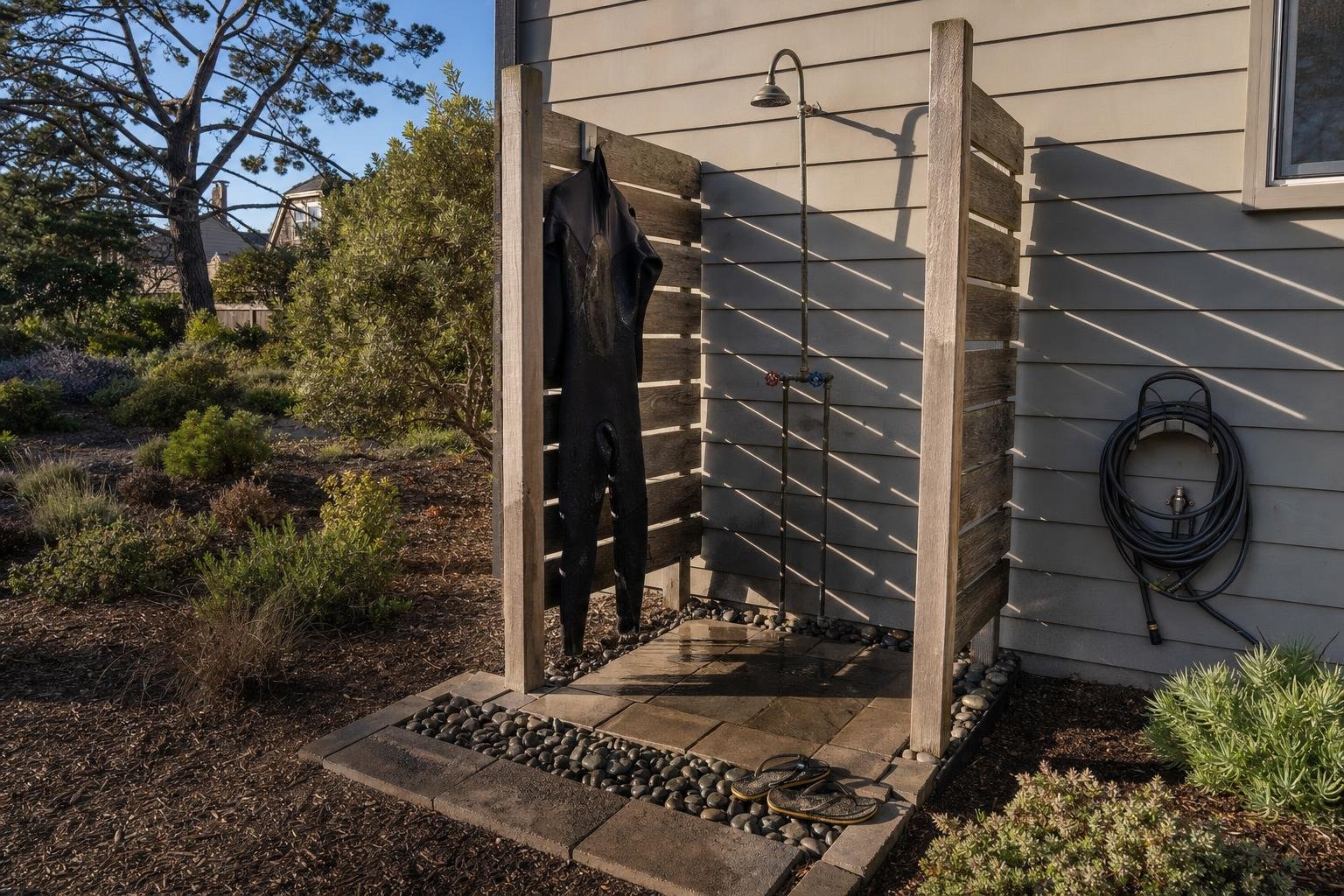
An outdoor shower is one of the few things we build that people use almost every day. In a town where half the household comes home with sand in everything, a place to rinse off before you walk through the door earns its keep fast. Here is what actually goes into one, and the local rule that catches people out.
Why they make sense here specifically
Most outdoor shower articles are written for vacation houses. In Santa Cruz it is a working fixture. Sandy feet after Twin Lakes, a wetsuit that needs fresh water on it before the salt eats the seams, a dog that found something dead at the harbor, kids coming up from the beach. All of that stops at the shower instead of tracking down your hallway.
Rinsing a wetsuit with fresh water every session is also the difference between a suit that lasts a few seasons and one that does not.
Hot, cold, or both
This is the first decision and it drives the cost and complexity of everything else.
Cold only is the simplest build. You are extending a cold water line, often off an existing hose bib, to a fixture on the wall. Fewer trades, less trenching, faster.
Hot and cold means tying into the house hot water supply, which means a longer plumbing run, more wall or crawlspace work, and thinking about how far the fixture sits from the water heater. A long run to a far corner of the yard wastes water waiting for it to warm up.
Our honest take after building both: people who put in cold only because it was easier often stop using it by October. Cold water is fine for a quick rinse in August. Hot and cold is what gets used year round, which is the whole point of building it.
Wall-mounted or freestanding
Wall-mounted against the house is the more common build and the easier one. The supply lines are already in that wall or under that floor, the structure is already there, and you are working against an existing surface.
Freestanding, out by the pool or at the side gate, means trenching supply lines out to it and building a post or a wall to hang the fixture on. More work, but sometimes it is the right call, usually when the good spot is nowhere near the house.
The thing to get right either way is the approach. Put it where you actually walk in from the car or the gate, not where it looks tidiest on a plan. A shower you have to detour to is a shower nobody uses.
Where the water goes, and the rule people miss
This is the part homeowners rarely see coming. Shower water is graywater by definition in California, along with water from tubs, bathroom sinks, and washing machines.
In Santa Cruz County, the only residential graywater system that is exempt from a permit is a laundry-to-landscape setup that takes water from a clothes washer, uses no pump or tank, and does not alter existing plumbing. Everything else, including an outdoor shower draining to your landscape, needs a permit. The county spells this out on its gray water systems page.
A few specifics from that page worth knowing before you pick a location:
- Graywater irrigation has to stay at least 4 feet from a sewage disposal field and 5 feet from a septic tank.
- It is not allowed on slopes over 50 percent.
- If your property is on a septic system, you will need an Environmental Health building clearance as part of the process.
The simpler path many people take is draining the shower into the sanitary sewer like any other fixture, which is a plumbing job rather than a graywater system. Either way, water cannot pond, run off onto a neighbor's lot, or reach the storm drain. On a small lot with a shower tucked against a side fence, that is a real design constraint, not a formality.
If you are in the city of Santa Cruz, Capitola, Scotts Valley, or Watsonville rather than the unincorporated county, check with that city's building counter, since they run their own permitting.
Materials that survive salt air
Coastal air is hard on cheap fixtures. What we have watched hold up:
- Fixtures. Marine grade stainless, brass, or solid bronze. Chrome plated pot metal from a big box store will pit and streak within a couple of winters within a mile of the water.
- Screens and framing. Cedar and redwood both weather well and can be left to gray out. Whatever you use, let it breathe and do not trap water against it.
- Floor. Set stone or concrete pavers over a proper base, with an open pebble bed to take the water. Solid slabs with nowhere for water to go get slick and grow algae in the shade.
- Fasteners. Stainless. Standard galvanized screws will bleed rust streaks down a cedar screen in a season.
Good hardscape work under the shower is what keeps the whole thing from turning into a mud patch, and it is the part people are most tempted to skip.
Privacy, sun, and wind
Six feet of screen handles the neighbors at ground level. What people forget is the second story next door and the uphill lot behind. Stand in the spot before you commit and actually look around.
Sun matters too. A shower in permanent shade stays cold, damp, and mossy. Afternoon sun on the spot dries it out between uses and makes it usable far more of the year. And on a west-facing lot, think about wind, because an open screen on the windward side turns a warm shower cold in a hurry. If the privacy screen is doing double duty as a windbreak, that changes how we build it and how it ties into any existing fence.
Frequently Asked Questions
Do I need a permit for an outdoor shower in Santa Cruz?
If it drains to your landscape, yes, it counts as a graywater system and needs one in the unincorporated county. If it ties into the sanitary sewer, it is treated as a plumbing job. Cities in the county run their own permitting.
Can I use the water on my plants?
Only through a permitted graywater system, and not on root crops or the edible parts of food crops. Ponding and runoff off your property are not allowed.
Will it get used in the winter?
If it has hot water, yes. Cold-only showers mostly get abandoned once the weather turns.
Get a Free Estimate
PGS Landscape Company has been building outdoor living spaces across Santa Cruz and Monterey County for over 40 years, from the fixture and the screen down to the drainage underneath. If you are thinking about an outdoor shower, call us at 831.254.3447 or reach us through our contact page and we will walk the spot with you.