




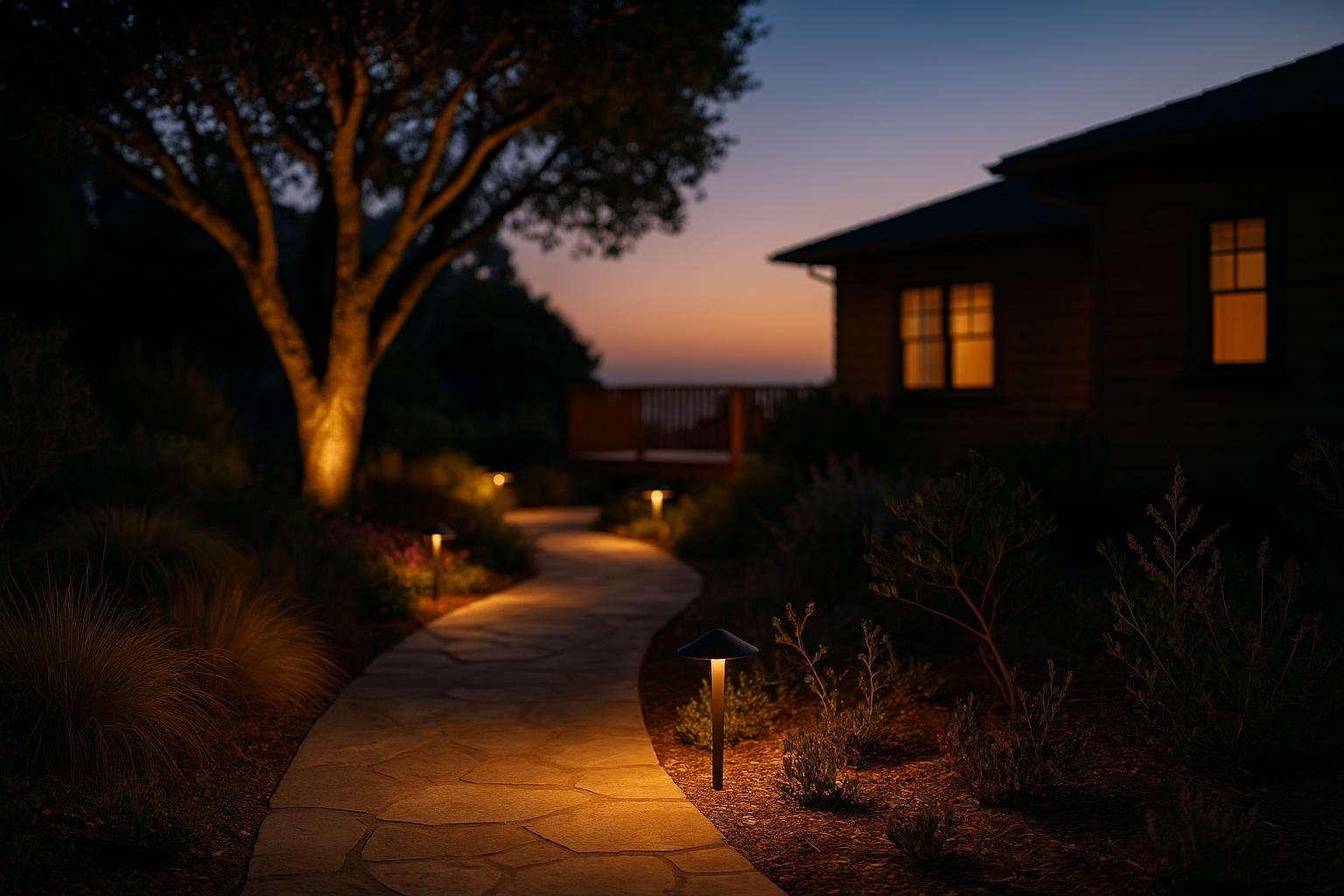
Good landscape lighting makes a yard usable after sunset and adds more curb appeal per dollar than almost anything else we install. We have wired up hundreds of yards across Santa Cruz County, from foggy lots in Pacific Grove to redwood-shaded properties in Felton. Most of the bad lighting jobs we get called to fix were not bad ideas, they were just installed with the wrong system for the site.
Low Voltage Is Almost Always the Right Call
Outdoor lighting splits into two systems. Low voltage (12V) runs off a transformer plugged into a standard outlet, with buried cable feeding the fixtures. Line voltage (120V) is wired directly into your home's electrical and requires permits, a licensed electrician for the rough-in, and conduit in most cases.
For residential yards in Santa Cruz County, low voltage wins on almost every job. It is safer (12V will not hurt you if you nick a cable with a shovel), faster to install, easier to reconfigure as the yard changes, and the LED fixtures available today are every bit as bright as anything line voltage offered ten years ago. We use low voltage on probably 90 percent of installs. Line voltage still has a place on big commercial properties or very long runs where voltage drop on 12V gets ugly, but a typical Aptos or Scotts Valley backyard does not need it.
The Five Lighting Types That Cover Most Yards
You do not need to know lighting design jargon. There are really five techniques that show up on almost every job:
- Path lights. Short fixtures (12 to 24 inches tall) along walkways and beds. Function is safety first, look second. Space them 8 to 10 feet apart, alternating sides of a path. Do not line them up like an airport runway.
- Uplighting on trees and architecture. A spotlight at ground level aimed up into a redwood, oak, or palm. Or aimed up the wall of the house to wash a textured stucco or stone facade. This is the technique that turns a yard into a yard at night.
- Downlighting from trees (moonlighting). Fixtures mounted high in a tree pointing down through the branches. It mimics moonlight on the ground. Subtle, expensive to install because you are climbing, but the effect is the best of any technique we use.
- Step and wall lights. Recessed into a retaining wall or under a stair tread. Pure safety lighting in spots where a path light would clutter the design. Almost always low voltage.
- Underwater and feature lights. Pool, pond, water feature. Always low voltage, always sealed for submersion. If you have a patio with a built-in water feature, we usually plan the lighting at the same time we plumb it.
A well-lit Santa Cruz yard might use three or four of these together. The goal is layers, not flooding the yard with brightness. Plan for shadow as much as for light.
What Fails on Central Coast Yards
After 40 years on these jobs in our climate, here is what fails:
- Cheap aluminum fixtures near the coast. Salt fog in Capitola, Pacific Grove, La Selva Beach eats aluminum and bare steel inside two seasons. Specify solid brass, copper, or stainless. The premium pays for itself the first time you would have replaced the cheap ones.
- Plastic transformers in the sun. They cook. Mount it in shade, ideally on the shaded side of the garage.
- Below-grade wire splices without proper waterproof connectors. Wet winters here find every cheap wire nut. Use gel-filled or heat-shrink connectors on every buried splice.
- Old halogen systems. If you still have a 15-year-old halogen system, the fixtures are usually still fine, the bulbs are the problem. Swap to LED retrofits and your power draw drops 80 percent. Do not let anyone sell you a whole new system if the brass is intact.
- Light pollution into neighbor windows. Tight Live Oak and Soquel lots especially. Aim, shield, and trim fixtures so light goes where it should and nowhere it should not.
Smart Controls, Worth It or Not
Almost every system we install now has at least a photo cell and astronomic timer (on at dusk, off at a set time or sunrise). For another few hundred dollars, you can add app control, scenes (party mode, security mode, holiday colors), and home-automation integration.
Our take, basic dusk-to-dawn control is a must. The full smart system is worth it if you actually use scenes or have a complex yard with multiple zones. Plenty of homeowners on the Santa Cruz coast over-spec the controls and under-spec the fixtures, then are disappointed three years later when the cheap heads corrode.
Frequently Asked Questions
Do I need a permit for landscape lighting in Santa Cruz County?
Low voltage systems do not require a permit. Line voltage (120V) wiring does, and you need a licensed electrician to make the home connection. If you are running new conduit from the panel, expect a permit and inspection from the county or city building department.
How long should a landscape lighting system last?
Solid brass and copper fixtures should last 20 to 30 years. LED bulbs run 30,000 to 50,000 hours, roughly 15 years of dusk-to-dawn use. The transformer and any controllers usually need replacement at 10 to 15 years. Cable buried correctly outlasts everything else.
Can I install path lights myself and have a pro do the rest?
Yes, we see this often. A DIY path-light kit now plus professional uplighting later is a fine phased approach. Just size the transformer on day one so it can handle future fixtures.
Get a Free Estimate
PGS Landscape has been installing landscape lighting in Santa Cruz County for over 40 years. We design systems that work with your hardscape, your trees, and our coastal climate, and we install fixtures that will still look good a decade in. Call us at 831.254.3447 or use our contact form for a free estimate.